After a WordPress Website Is Built, Should You Operate It Yourself or Leave It to the Development Team?
When building, redesigning or taking over a WordPress website, which responsibilities belong in-house and which suit a provider? This guide separates content operations, growth decisions and technical maintenance to clarify deliverables, access and ongoing ownership.

1. A recurring client question: who manages the website after it is built?
Several website consultations have led to the same question:
After launch, should the client's own team manage the site, or should the website development team continue operating it?
These clients all want control over their products and websites.
If every product launch, price or information change and article publication must pass through an external team, responses may slow and the company may struggle to control its own content.
But “We will operate it ourselves” still does not define either side's responsibilities.
Does self-operation mean uploading products, publishing articles and editing pages, or also keyword assessment, content planning, data analysis, system updates, backups and troubleshooting?
Delegating everything can create concerns about dependency. Bringing everything in-house creates hiring, training, coordination and expertise challenges.
The real question is therefore not merely whether staff can use the CMS:
At the company's current stage, which work should stay in-house, and which can a provider handle more efficiently?
2. The underlying problem is mixing three kinds of work
After a site is built, at least three kinds of work coexist. They require different people, experience and investment.
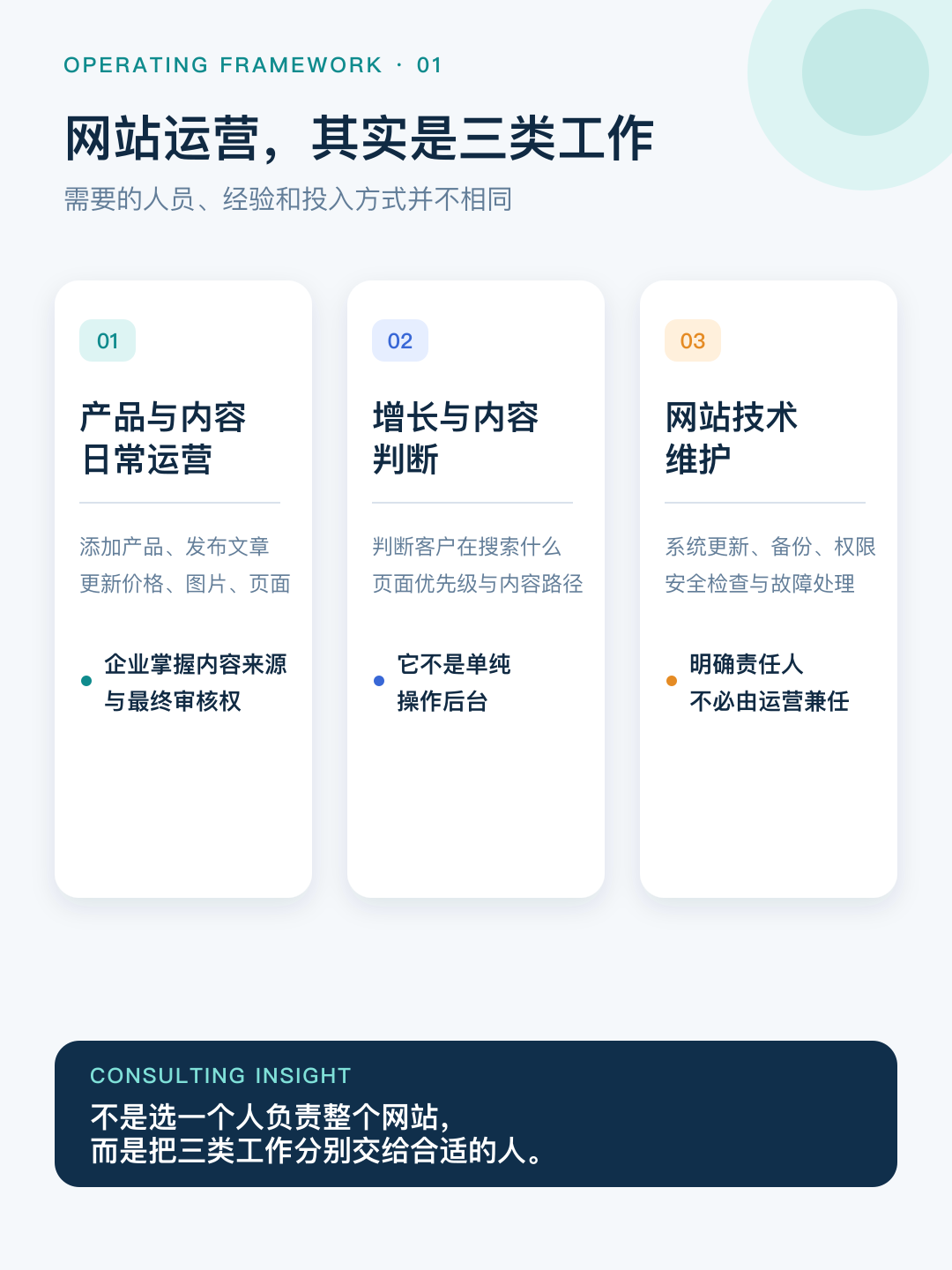
First: everyday product and content operations
This includes adding products, changing prices and information, publishing articles, replacing images and updating frequently used pages.
Product facts, customer questions, sales priorities and brand wording come from inside the business. A provider cannot be expected to guess them indefinitely. Whoever executes the work, the company must control the source information, review rights and publication schedule.
Second: growth and content decisions
This includes understanding what target customers search for, which pages deserve priority, how products and content should connect, where investment needs adjustment and what the data suggests doing next.
This is more than operating a CMS. It requires business understanding and experience in search, content and conversion.
Third: technical maintenance
This includes WordPress, theme and plugin updates, backup and restoration, account permissions, security, troubleshooting and changes that may affect site structure or data.
The person responsible for products and articles does not necessarily need full administrator access or the responsibility for technical maintenance. Technical ownership must be clear, but the owner may be internal or external.
The answer is therefore to assign each kind of work appropriately, rather than find one person to “manage the whole website.”
3. How are these responsibilities usually divided?
The following comparison presents common arrangements, rather than a fixed answer. Companies should choose for their current stage instead of assuming everything must immediately move in-house.
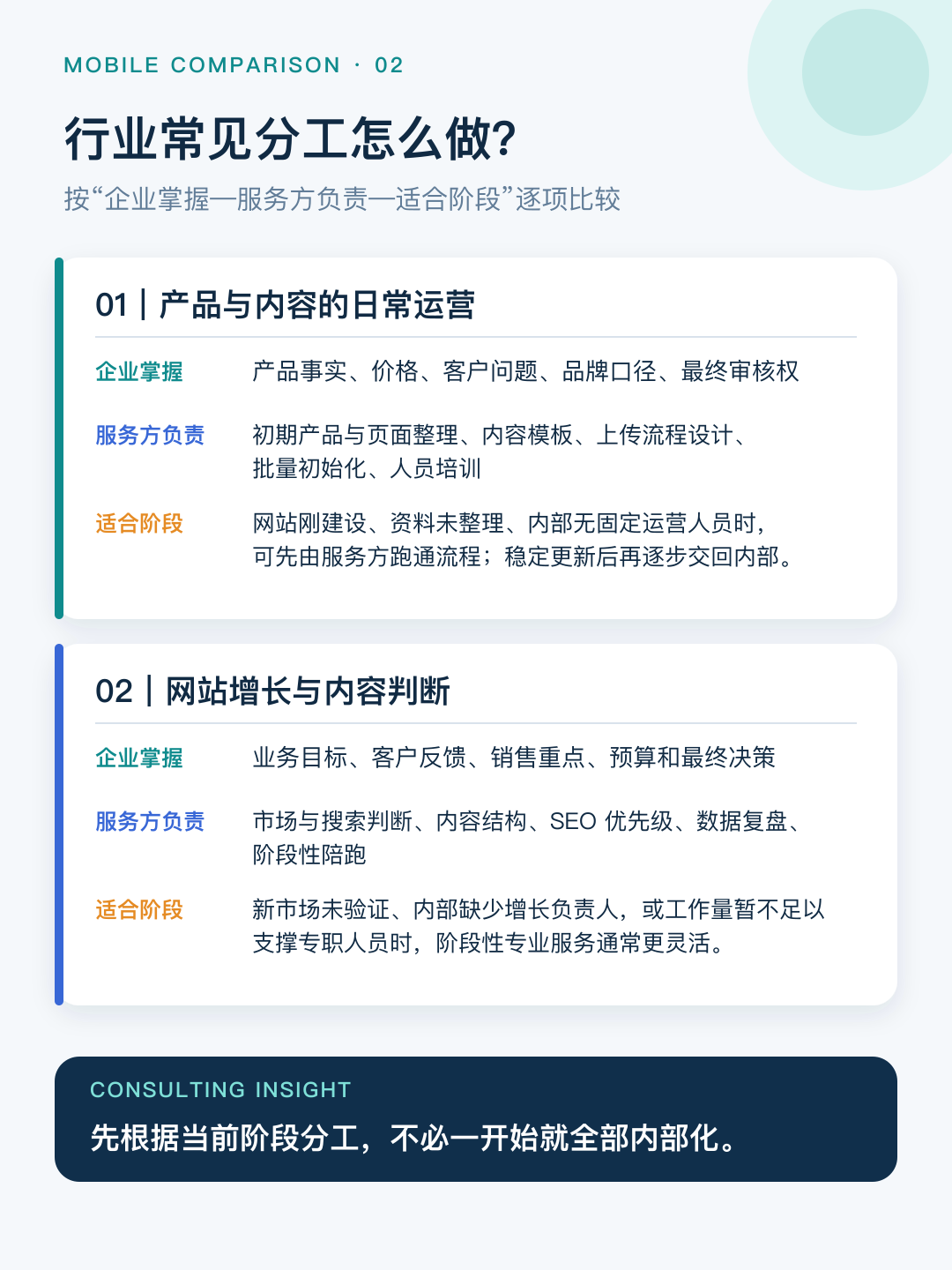
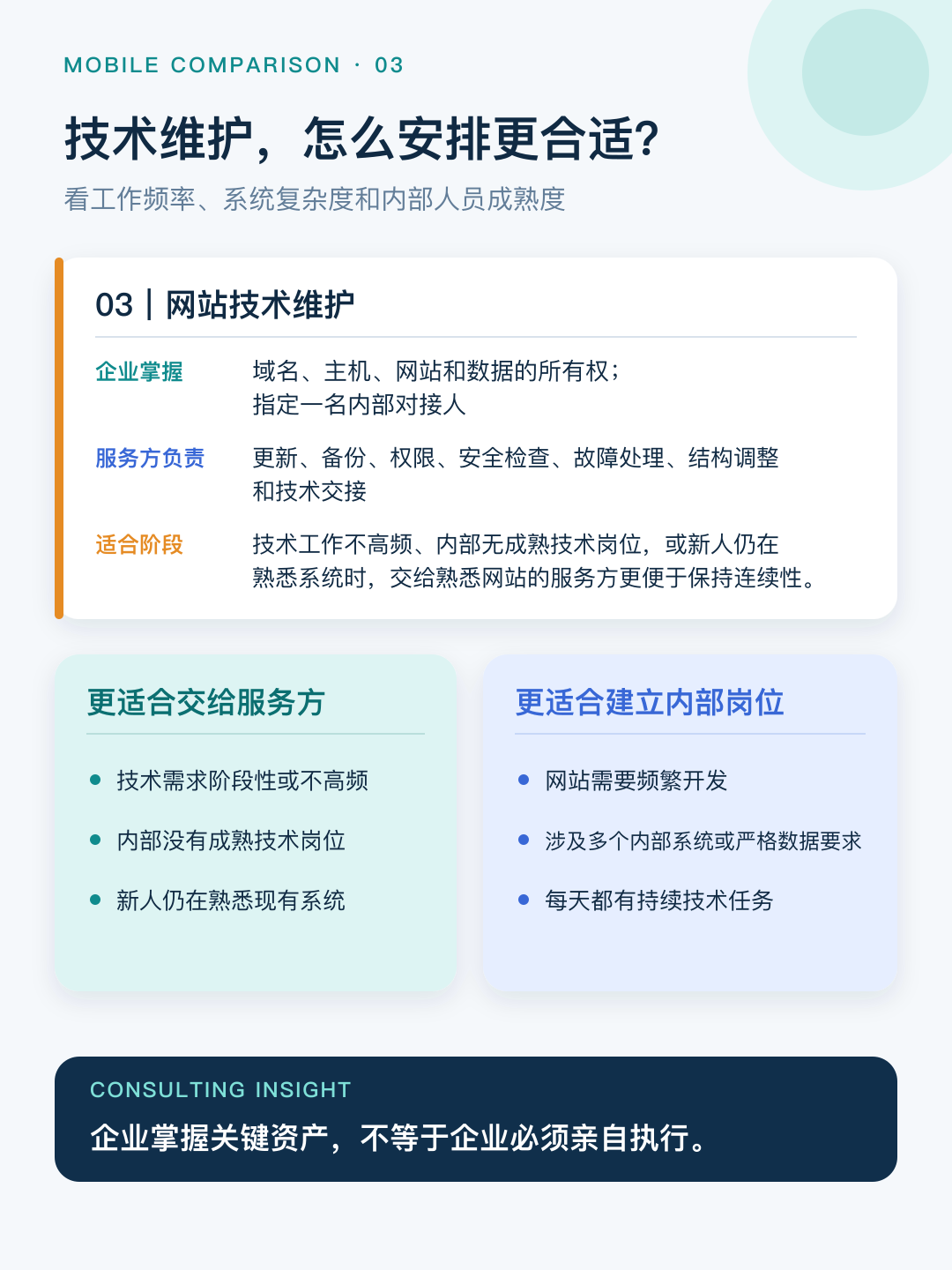
One distinction is easy to miss: company control does not mean the company must execute every task itself.
The business can retain ownership of domains, accounts, product information and data while authorizing a provider to perform work for a particular stage. Clear ownership, permissions and handover arrangements allow delegation without losing control.
Conversely, bringing every task in-house is not automatically cheaper or more efficient.
Staffing costs are more than salary
A new operations or technical employee must be recruited, learn the business, understand the existing site, master the tools and establish working relationships.
If the website workload is not yet steady or its direction is unproven, there may not be enough continuous work for a full-time role. One person may also be unable to cover content, SEO and technical maintenance.
A provider's value is then to supply established expertise when needed and get the website and workflow running. As workload stabilizes and internal staff become available, frequent tasks can gradually return to the company.
Technical staff also need time to learn the system
Even a newly hired developer must learn which themes and plugins the site uses, what was changed previously, where accounts and backups are kept and how recovery works.
If technical requirements arise only periodically, continuity with a team that already knows the site is often more efficient than training someone new.
Frequent development, multiple internal systems, strict data requirements or daily technical tasks may justify an internal technical role. The deciding factors are workload, risk and business importance, rather than an assumption that an employee is always better.
4. Our approach: adapt the service scope to the company's stage
We do not require clients to choose once between doing everything themselves and delegating everything to us. We assess their current stage and decide how much responsibility the provider should take.
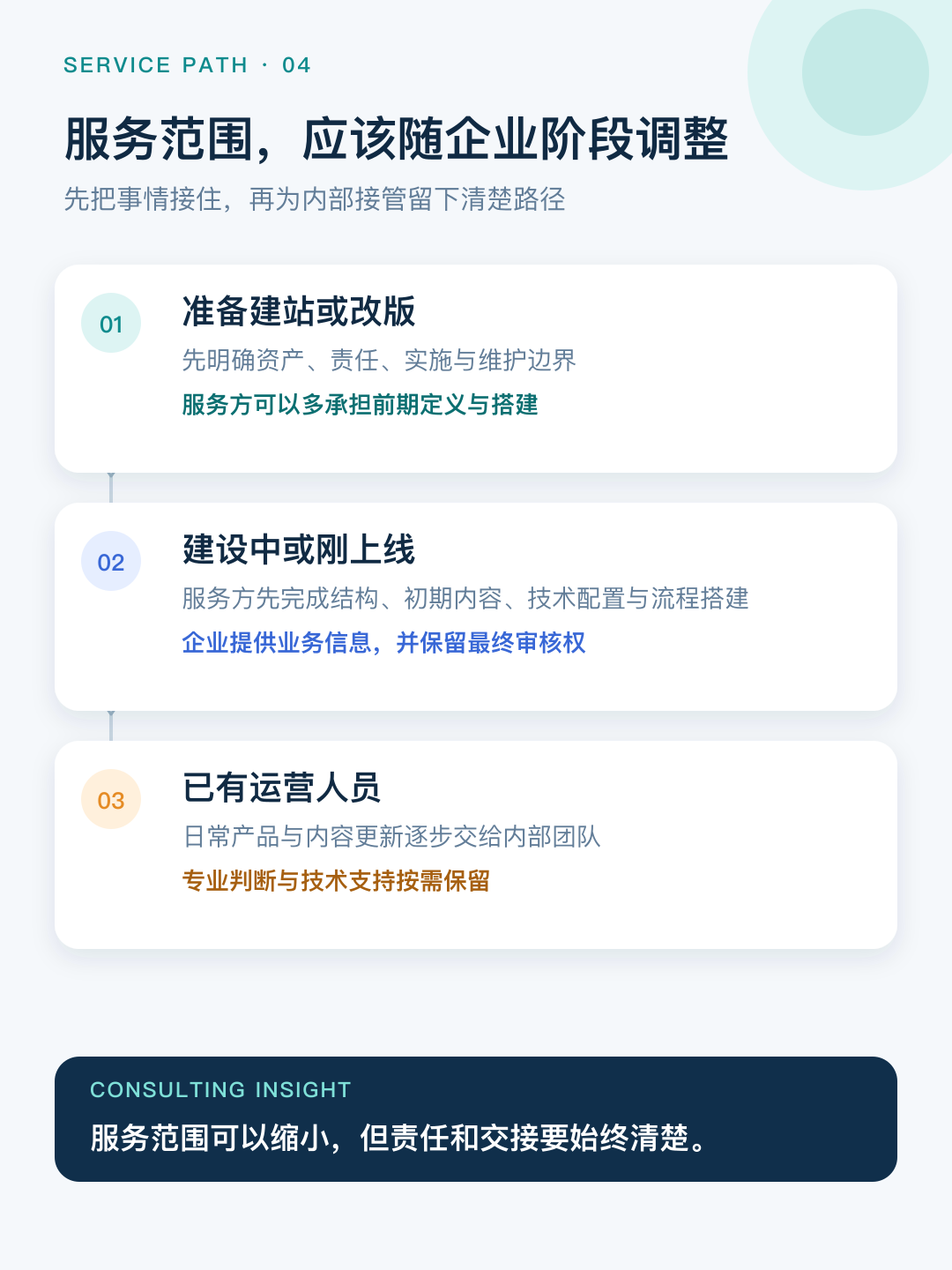
Stage one: preparing a build or redesign, with unclear responsibilities and scope
A common problem is a growing feature list without answers about who will operate or maintain the site, or how delivery will be accepted.
We examine business goals, the current site and assets, product updates, internal staff and the capabilities the company wants to retain. Where needed, a diagnosis or solution-definition phase clarifies:
Accounts, data and content assets the company must control;
Everyday tasks it will perform itself;
Initial organization, development and technical work assigned to the provider;
Post-launch maintenance, advisory support and handover boundaries.
More provider involvement at this point does not require permanent outsourcing. It can avoid hiring a full team before the direction is clear and give later hires well-defined roles.
Stage two: the site is being built or has just launched, without a complete internal team
The provider can establish structure, initial content organization, technical configuration and workflows. The company supplies product, customer, market and sales knowledge and retains final review authority.
At handover, we turn frequent operations into practical tasks rather than simply demonstrating CMS menus. Depending on the scope, deliverables may include:
Product and content training, with recordings;
Instructions for common workflows;
An inventory of accounts, permissions and key assets;
Responsibility boundaries between company and provider;
A defined period for post-delivery questions;
The duration and deliverables of any continuing maintenance or advisory support.
The purpose is to ensure someone takes responsibility as operations begin, while leaving a clear path for a later internal takeover.
Stage three: operations staff are in place and the company wants stronger internal capability
Routine product and content updates can move to the internal team, while the provider focuses on specialist judgment and technical support.
A growth adviser can periodically help prioritize content and SEO, review data and adjust direction. Technical staff handle updates, backups, faults and structural changes. Occasional work does not require a permanent full-time position in every specialty.
As the internal team matures, the service scope can narrow further, retaining only technical maintenance or periodic advice if appropriate. Our goal is to have the right person responsible at each stage, rather than make the client dependent on a provider.
What distinguishes our approach
**We do not start with tools:** business goals, existing assets, people and future operations determine the website approach.
**We do not require premature internalization:** work better handled by a provider at the current stage can start with us and transfer as the team matures.
**Technology and growth are assessed separately:** technical specialists handle the build and engineering issues; growth advisers handle SEO, content and conversion. Cross-disciplinary questions are assigned according to the main obstacle.
**Clients retain key assets:** ownership of domains, accounts, data and content is established at the outset. Delegating execution does not mean losing control.
**Cooperation has verifiable boundaries:** training, documentation, permissions, maintenance, advice and handover become explicit scope, rather than an undefined promise of “support afterward.”
Reference material:
WordPress documentation: Roles and Capabilities (https://wordpress.org/documentation/article/roles-and-capabilities/)
WordPress documentation: Updating WordPress (https://wordpress.org/documentation/article/updating-wordpress/)
NOWUPDATING's current Website Growth Diagnosis service description
Related reading
Building a Multilingual Website: Translation Plugins, Subdirectories or Subdomains?
Why Has a Six-Year-Old Export Business Website Failed to Generate Growth?
Discuss how to operate your website
Share your team responsibilities and the work you want to commission, whether it is website operations, SEO content or technical support.