You Paid for an English Export Website. Why Is It Still Struggling Six Years Later?
Your English website has run for years and contains many product pages, yet generates almost no Google traffic or qualified inquiries. This anonymized diagnosis separates credibility, inquiry conversion and search growth to help decide what to retain, restructure or improve.

1. An English site nearly six years old, with only one page recorded in AI visibility data
Recently, a company exporting industrial abrasives and abrasive tools approached us to revive its English-language website.
This was not a new site starting from nothing. It had operated for nearly six years and accumulated company information and product pages.
The client initially assumed that this history must have built up some search and content assets. Our preliminary diagnosis was less encouraging.
In this Semrush research, the AI visibility report showed an overall signal close to zero, with only one cited page recorded. Meaningful organic page traffic was also scarce. The limited signals were even concentrated around an isolated product-specification term that did not reflect the company's actual product lines.
One qualification matters: a website's six-year history does not mean it should necessarily have high AI visibility.
Domain age and page count do not automatically become rankings, traffic or AI citations. Semrush's figures are directional signals based on the prompts and answers it covers, not a complete picture of every AI platform. A citation is not a recommendation, and neither proves that inquiries have resulted.
But when a site has operated for nearly six years, contains many pages, still has weak search signals and appears in the AI report with only one cited page, further investigation is warranted: what has the site actually been accumulating?
2. The issue is not whether the site uses English, but whose logic it follows
Further inspection revealed a familiar pattern.
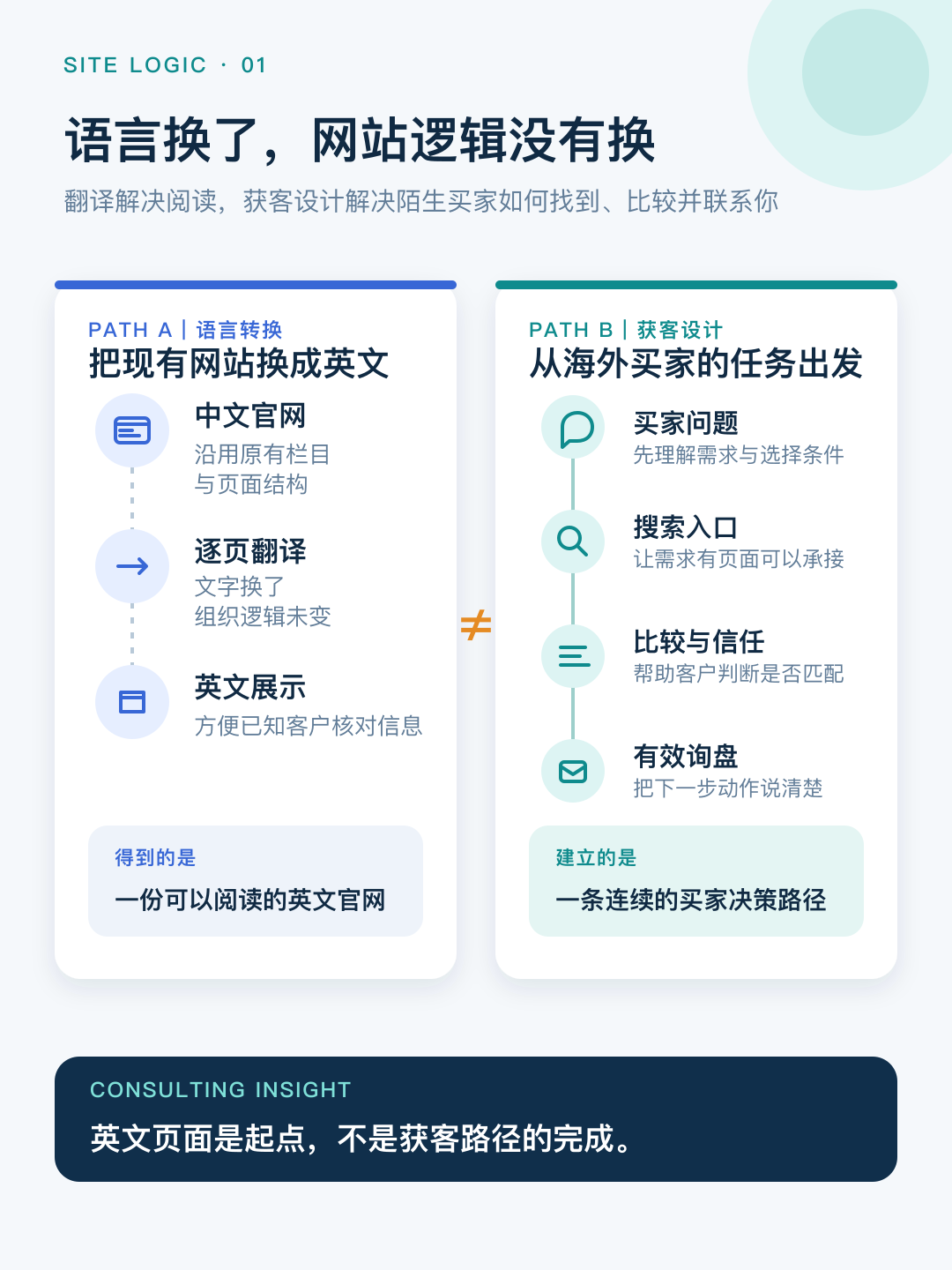
The company's Chinese website had an English switch, which led to another domain. Separate URLs or domains for Chinese and English are not inherently problematic. The issue was that the English site changed the language while almost entirely copying the Chinese site's structure and expression.
It still followed the pattern of a domestic corporate brochure site:
Company profile, corporate information, product center and careers appeared as parallel sections;
Very different abrasive raw materials and finished abrasive tools shared one Products entry point;
Products had pages, but lacked clear categories based on overseas buyers' selection methods, purchasing questions and searches;
Pages mainly answered “What do we have?” rather than “Who is this for, how should you choose, why trust us and how do you request a quote?”
As translation and presentation, the English site was not empty. Overseas customers who already knew the business through trade shows, salespeople or referrals could still check company and product information.
But if the goal was for unfamiliar buyers to find products through Google, compare suppliers and submit qualified inquiries, the structure was insufficient.
Our initial assessment was:
The site was primarily an English copy of the Chinese corporate website. It provided an English presentation without rebuilding the product structure, search entry points, trust-building content and inquiry journey for overseas customer acquisition.
That is why we did not begin with templates or homepage styling. We first assessed what job the site was actually doing.
3. Many clients ask for customer acquisition but buy English pages
This situation is common, without necessarily involving deliberate misrepresentation.
A business owner tells a provider, “I want an export website that helps acquire customers.”
During requirements and pricing discussions, the conversation often shifts to:
How many pages to build;
Which style and template to use;
How many products to upload;
Whether Chinese and English switching is included;
Whether it includes news, forms and a CMS;
When the site will launch.
These items define how a website gets built. They do not explain where customers will come from, which pages serve search demand, how trust is established or how inquiries develop.
The provider completes the page list, and the client sees the site launch and assumes customer acquisition has begun. Years later, without sustained traffic or inquiries, both discover that the contract delivered a website while the client expected an acquisition system.
The issue is therefore whether the client understood before signing that it was purchasing English presentation alone, or also inquiry conversion and search-growth design.
4. An export business website has at least three jobs
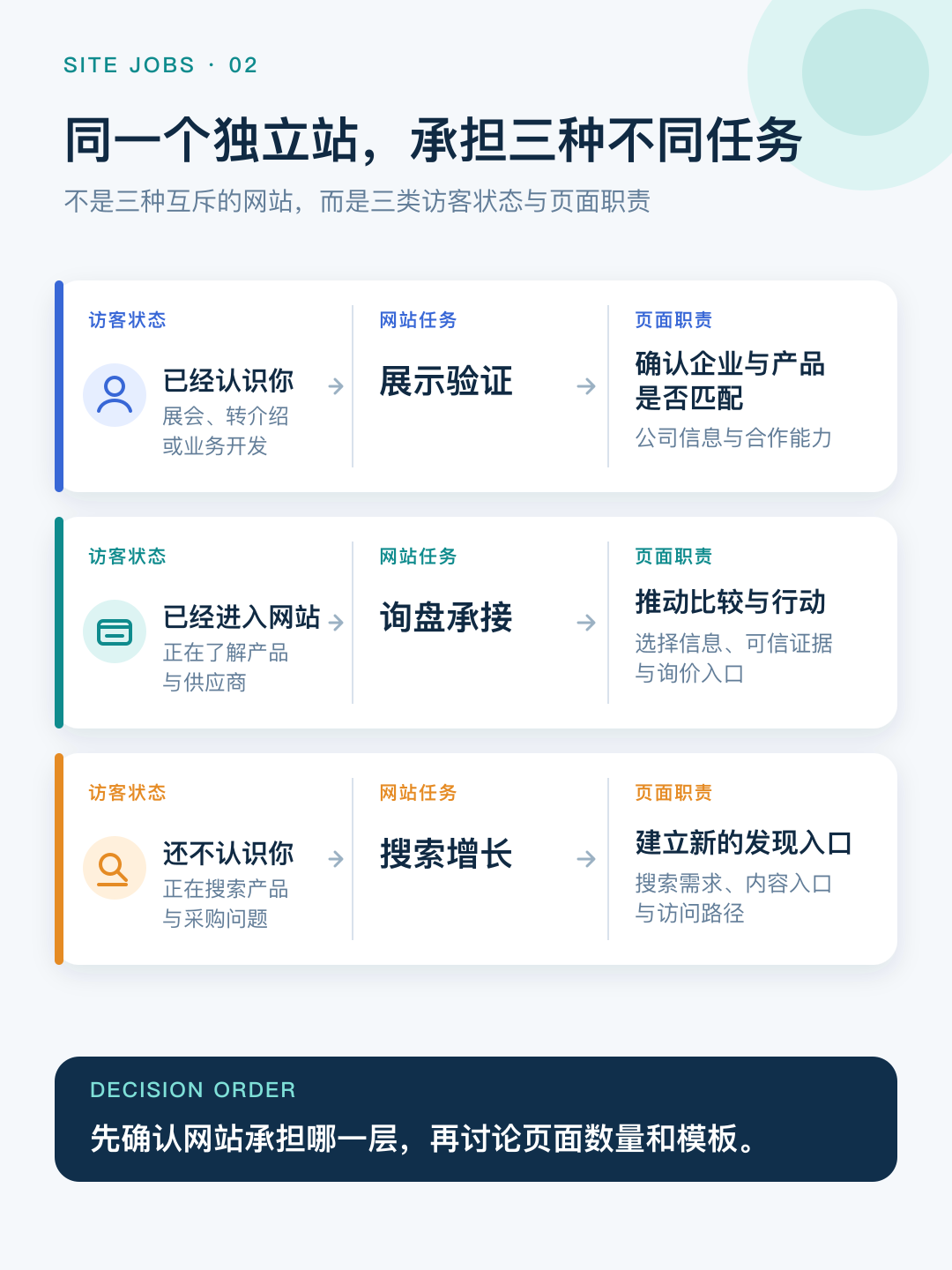
These are not mutually exclusive website types. A mature site usually performs all three, with different priorities at different stages.
Layer one: credibility checks—help people who already know you confirm who you are
Visitors may come from trade shows, sales outreach, referrals, advertising or branded searches. They want to confirm that the company is real, its product range fits and it has basic capabilities and contact details.
This has value. For companies acquiring customers mainly through offline outreach and sales teams, the website is important supporting evidence.
The old English site in this case mainly fulfilled this first job.
Layer two: inquiry conversion—give visitors reasons to contact you
Visitors next need to decide which product fits their application, whether the company can supply the necessary specifications, quality control or customization, and what information a quotation requires.
The site therefore needs more than product listings: clear categories, applications and solutions, credible evidence, next steps and inquiry forms that collect meaningful requirements.
The abrasive raw materials and finished tools in this case serve different purchasing needs and selection parameters. Mixing them in one product dropdown makes it difficult for buyers and search engines to understand each page's purpose.
Layer three: search growth—help buyers who do not know you find you
If a company wants new buyers from Google, the website project must also answer:
How will target buyers search for products and problems?
Which page serves each group of search needs?
What are the distinct roles of product, category, application and content pages?
How do visitors move clearly between pages?
Which old URLs and content should be retained, consolidated or redirected?
Who continues adding content, examining data and adjusting pages after launch?
Google's current public guidance on AI search also emphasizes that generative search still rests on search fundamentals: clear technical structure, discoverable internal links and content with distinctive value. These foundations do not guarantee rankings, AI citations or inquiries. Without them, however, sustainable growth is difficult.
5. Look beyond “SEO-friendly” when assessing acquisition design
Clients do not need to become developers or SEO experts to assess a proposal. Before signing, clarify at least six things.
1. What is the site's main business goal now?
Will it support trade shows and sales outreach with credibility, attract organic traffic, convert advertising visits into inquiries or take online orders? Different goals require different pages and features.
2. Which buyers and products does the first phase serve?
“Overseas customers and all products” remains too broad. Identify target markets, buyer roles and priority products first, or keywords, content and structure will lack priorities.
3. Are products reorganized around how buyers choose?
Translating Chinese product information page by page creates an English catalog. How to organize product lines, applications and purchasing parameters must be decided before page design.
4. Does each search need have a corresponding page?
A keyword list alone is insufficient. Which page covers each group of keywords and customer questions? Which pages attract search visits, and which support comparison and inquiries?
5. Who designs the trust and inquiry journey?
Are case studies, quality capabilities, certifications, customization information, quotation actions and form fields included? Who handles submissions? A Contact Us page cannot stand in for all of this.
6. How will results be measured, and who operates the site afterward?
Which pages receive impressions and visits? Which quote requests, forms and bookings matter? Who reviews data, adds content and adjusts pages? Work excluded from the quote cannot be assumed to be part of a one-time build.
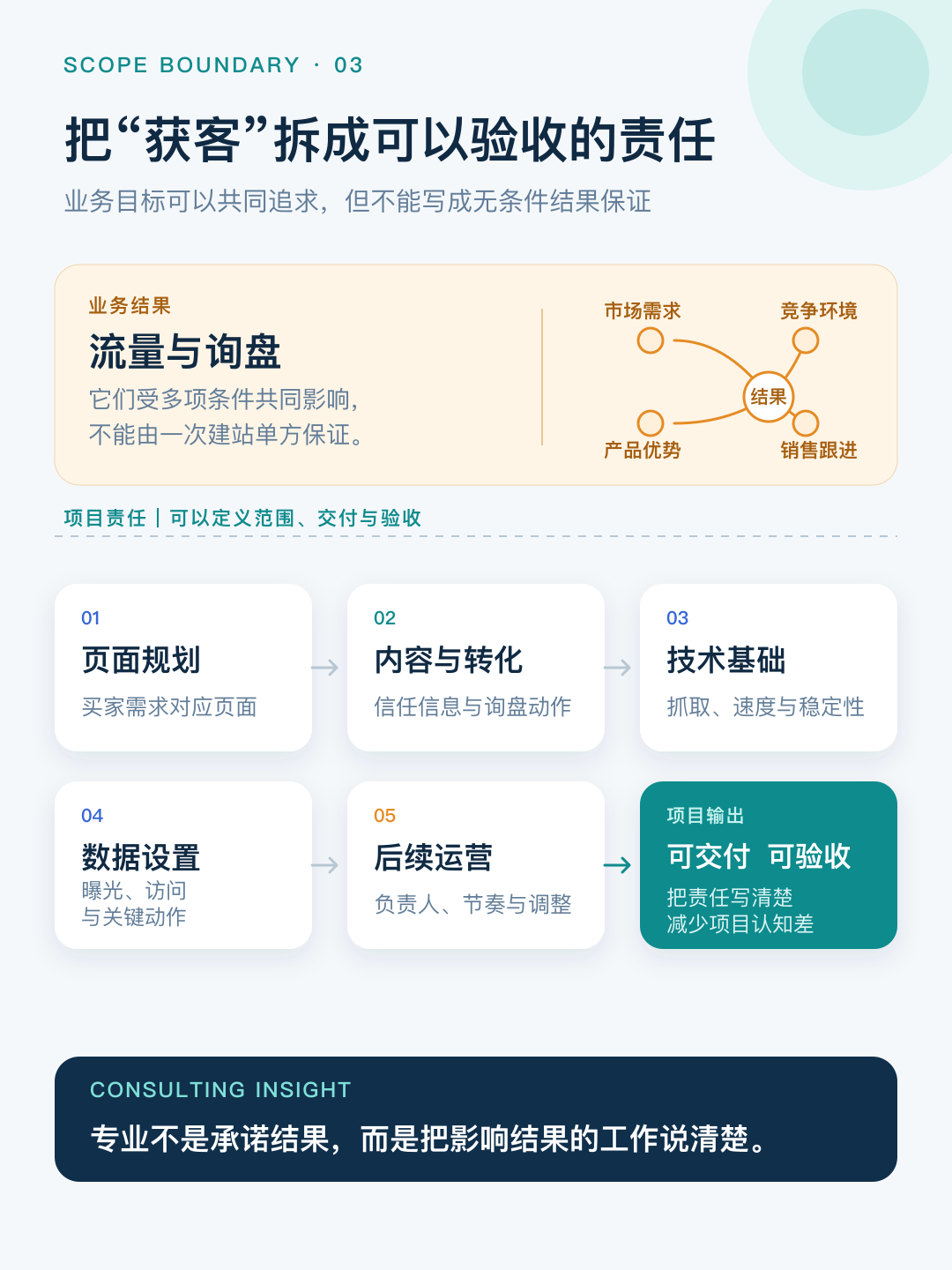
Traffic and inquiries can be business goals, but should not exist only as promised results. Break them into page planning, content and conversion design, technical foundations, measurement setup and ongoing responsibilities, with separate deliverables and acceptance criteria.
Responsibility for product content, growth decisions and technical maintenance also belongs in pre-build planning. We discuss that division in “After a WordPress Website Is Built, Should You Operate It Yourself or Leave It to the Development Team?”
6. A six-year-old site needs more than a new template, but should not be wiped clean
The company initially asked us to “get the website going again.” After diagnosis, we did not recommend treating it as a new site with no value.
Even without stable traffic, six years of operation may leave indexed URLs, product information, backlinks and historical data. Rebuilding from scratch could lose those assets. Changing only homepage and product-page styling would leave the category, page-purpose and inquiry-journey problems intact.
Our current recommendation is therefore: retain the English domain, redesign the site's information architecture and core pages, then handle old pages in stages.
First determine:
Which old URLs and content deserve retention;
Which pages need rewriting, consolidation or redirects;
How to recategorize the two product lines;
Which pages should first serve search, trust and inquiry needs;
Whether the existing CMS supports the new structure, updates and data requirements.
This is neither a cosmetic reskin nor complete demolition. It is a structural redesign based on the site's existing assets.
If your old site uses WordPress, also see “Competitors Are Producing Content Quickly with AI. Should You Rebuild a Ten-Year-Old WordPress Site?” to assess continued maintenance, targeted upgrades or a full rebuild.
Related reading
Should SEO for an Export Business Website Start Before the Build or After Launch?
Competitors Are Producing Content Quickly with AI. Should You Rebuild a Ten-Year-Old WordPress Site?
What does your website need next?
If your export website needs updated content, search work or a redesign, tell us about the site and your current business priorities.