Building a Multilingual Website: Translation Plugins, Subdirectories or Subdomains?
You have an English website and want to add French, Spanish or other languages, but are unsure how translation plugins, subdirectories and subdomains fit together. This guide distinguishes reading assistance from search-led acquisition, then explains URL structures, translation storage and when each approach fits.

A client asked: does every language on a multilingual website need its own URL?
Recently, an export-business client asked us about adding languages to its website.
The company already had an English site and planned to add French, Spanish and other languages. Its team wanted to update products independently and have local customers find these pages through Google.
The client had two questions:
Is installing a translation plugin enough?
Does every language need a separate URL?
These are common sticking points for export businesses building their first multilingual site.
On the surface, the choice appears to be between plugins, subdirectories and subdomains. The first decision is actually whether the additional language pages only help visitors read, or whether they must also attract customers through search.
If customers already reach the site through trade shows, email or salespeople and simply cannot read English, a page translation tool may be sufficient.
If the company wants customers to find it while searching in their own language for products, applications or suppliers, it needs language pages that can be accessed independently and retained over time. Each page will normally need its own URL.
Clarify that purpose before discussing site structure.
What are the usual approaches?
There are two common types.
The first translates the original page directly. Visitors select a language and the text changes, but the URL may remain the same. This is quick to launch and mainly addresses visitors' inability to read the page.
The second creates separate pages for different languages. For example:
English:
example.com/product/French:
example.com/fr/product/German:
de.example.com/product/
These pages have their own URLs and can be opened, edited and updated separately. They are also better suited to serving as entry points from local search.
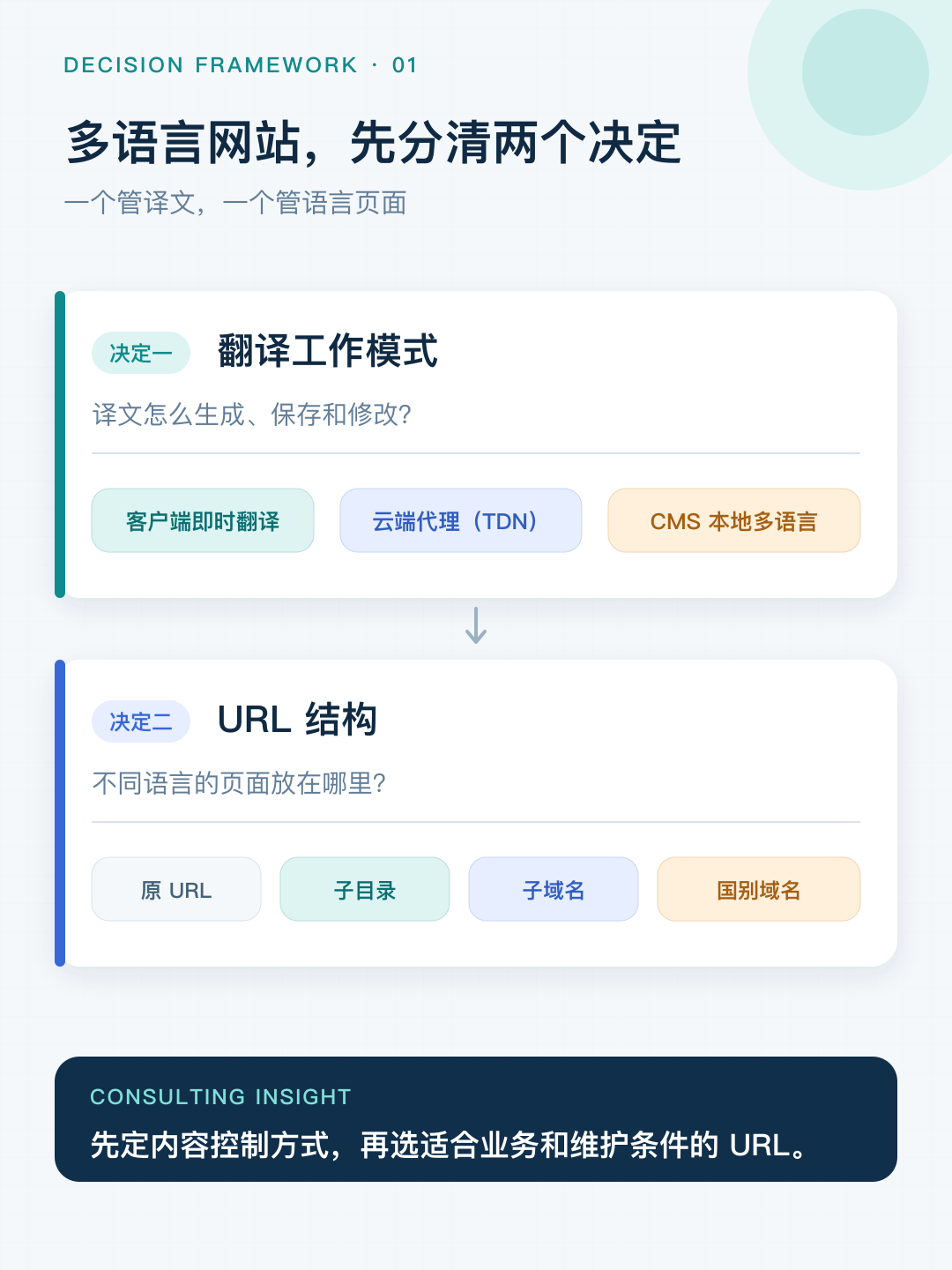
Once you create separate pages, you need to decide where they belong. Common options are subdirectories, subdomains or separate country-code domains.
A translation plugin and a URL structure are therefore different decisions. The plugin handles how content is translated; the URL structure determines where the language pages live.
What are the advantages and disadvantages?
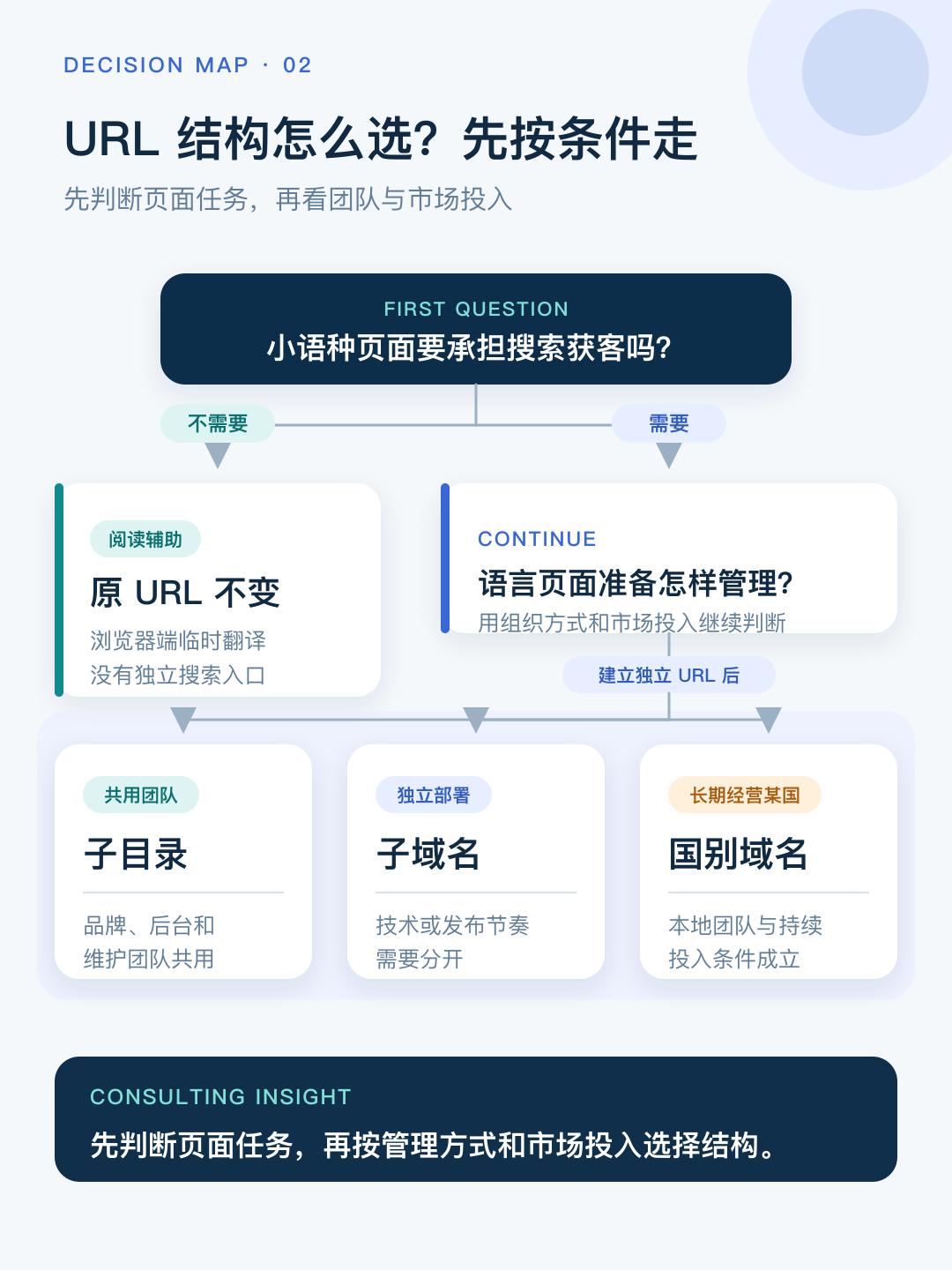
No single approach fits every business.
Subdirectories do not automatically rank better, and subdomains are not automatically more professional. Structure is a foundation. Content quality, local demand, maintenance and promotional investment also affect results.
Consider how translations are stored too
The comparison above concerns URL structure. When choosing tools, also ask who generates the translations, where they are stored and how much control the business has over edits.
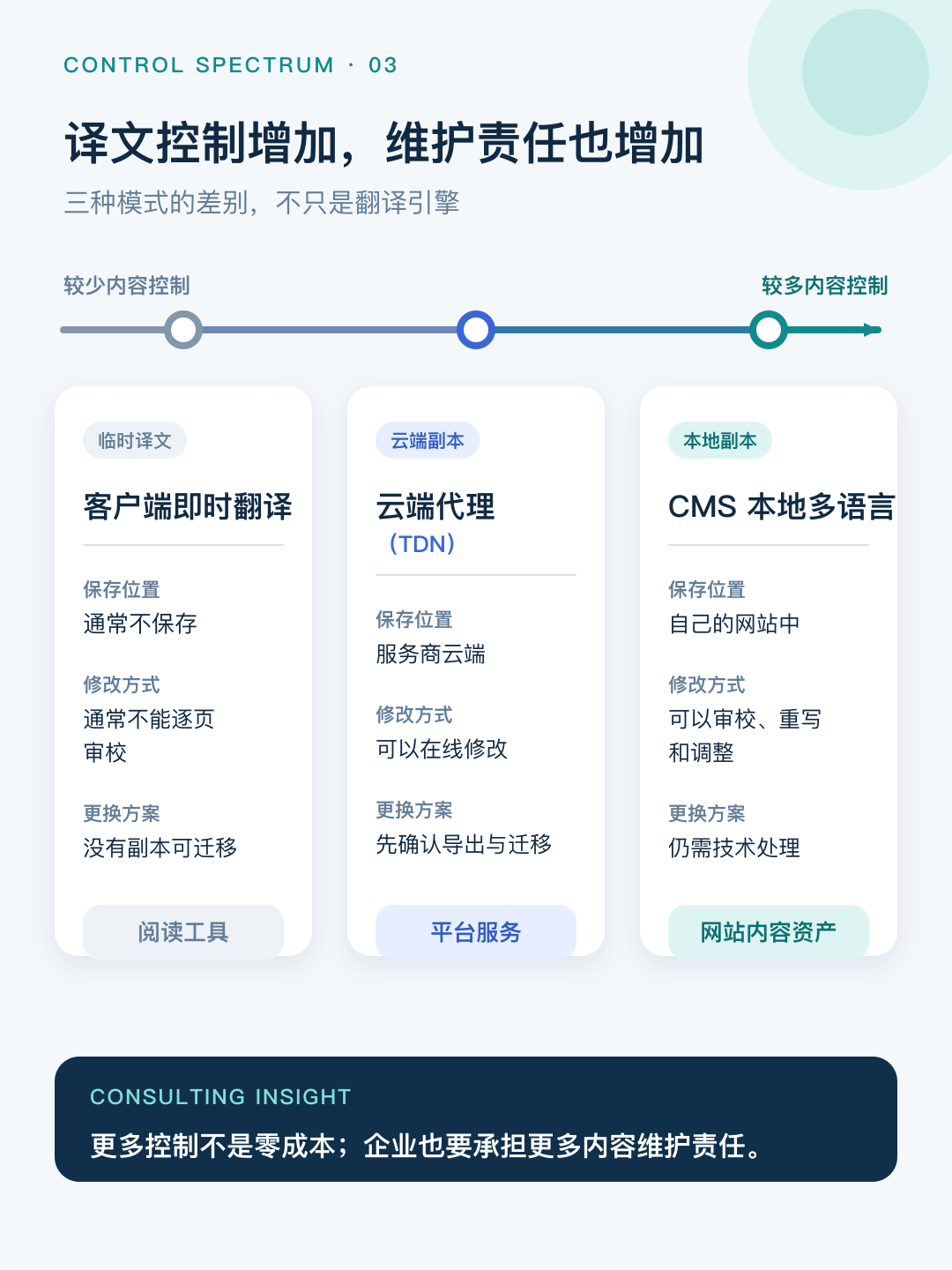
These three models may use the same machine-translation engine. The real distinction is whether translations become content the company can retain long term, and whether its team can keep checking and improving them.
In simple terms, instant client-side translation is a reading aid; a translation delivery network, or TDN, puts translation and delivery in the provider's cloud; and solutions such as WPML manage translations as website content.
Note: Google's official Website Translator Widget has limited eligibility. Commercial sites should not assume it is a generally available long-term solution.
How should a business choose?
Start with four questions.
Is the new language only helping existing customers read, or should it acquire new customers through local search?
Does this market already have customers, inquiries or a sales plan, or is it currently just an idea?
Does the English site already have stable traffic, backlinks or important pages?
After products change, who updates translations, images, specifications, downloads and contact details?
If the purpose is reading assistance, start with a page translation tool. The project need not be complex from the outset.
If language pages must support customer acquisition over the long term, give them independent URLs. When the brand, CMS and team are shared, subdirectories are usually easier to manage.
If different teams manage different markets, or technical systems need separate deployments, consider subdomains.
Consider country-code domains once the business commits to a country for the long term and is prepared to invest continuously in local content, promotion and maintenance.
Another common situation is an English site that has been running for years. Here, adding languages also requires reviewing existing pages and URLs first. Arbitrary structural changes can damage accumulated search traffic and backlinks.
For most export businesses starting with multiple languages, a more dependable approach is to choose one market with a real business opportunity, validate it with a limited set of products and pages, then decide whether to expand.
What services can we provide?
We do not begin by recommending a plugin. We first examine the intended market, existing website assets and whether the team can maintain the site over time.
Depending on the project's stage, we can provide:
01. Website growth diagnosis
For businesses that know something is wrong with their website but are unsure what to change first or whether to add languages.
The RMB 500 paid diagnosis includes a review of materials beforehand, a 60-minute online discussion and a one-page diagnostic summary. Its purpose is to identify the main issues, priorities and next steps. It does not include a complete solution design or code changes. If the client subsequently adopts our proposal to upgrade the site, this fee is credited toward that work.
02. Multilingual website solution definition
For businesses ready to proceed but still unclear about the existing site, multilingual content and technical scope.
We define initial markets and products, language-page structure, treatment of existing assets, content responsibilities, implementation scope and acceptance criteria. The resulting plan can be implemented by the client's team, us or another provider.
03. Focused implementation or ongoing advisory support
For businesses with clear goals, materials and acceptance scope. We can implement the work or support the client's team or existing provider, checking results at key stages.
Our strengths are mainly in how we work:
Examine business goals and the existing site before selecting tools;
Consider search, content, technology and subsequent maintenance together;
Define the plan and delivery scope clearly, without using technical details to lock clients in;
Make no promises about Google rankings or inquiry counts; base decisions on the actual market, website and materials.
Reference material:
Google Search Central: Managing multi-regional and multilingual sites (https://developers.google.com/search/docs/specialty/international/managing-multi-regional-sites?hl=zh-cn)
GTranslate: Differences between free, paid and TDN options
WPML: How translations are stored in the WordPress database (https://wpml.org/documentation/support/wpml-tables/)
Related reading
Plan your multilingual website structure
Share your current URLs, target markets and editing process if you need to add languages or restructure a multilingual site.