
Should SEO for an Export Business Website Start Before the Build or After Launch?
When building or redesigning an export website, when should SEO enter the process? This guide separates direction before the build, implementation during it and data-led work after launch, helping planning and development stay connected.

A recent client asked about SEO-focused website development. He wanted the site to launch with an SEO marketing foundation so target customers could find his products and website through Google.
This is a common expectation, but it contains two different needs: whether Google can discover and understand the website, and whether the site has suitable pages to compete when customers search for particular products and problems.
Titles, metadata and sitemaps mainly address the first. They matter, but do not decide which market to pursue, which products to promote or which pages customers need.
A site with SEO foundations will not automatically receive search traffic after launch. A site built for search-led acquisition needs SEO at three points.
Should SEO happen before the build, or through operations after launch?
It is not an either-or choice.
If SEO starts only after launch, navigation, product categories, page types and URLs are usually already fixed. Discovering missing pages can mean rework. Conversely, advance planning does not remove the need for later attention: actual queries and visitor behavior only become visible after launch.
The three stages answer different questions:
Before the build: establish direction and decide what the site should do.
During the build: implement the plan.
After launch: use data to decide what to optimize next.
First point: establish direction before the build
**The question:** which markets, products and pages should the first version prioritize?
Many companies begin with their catalog: one page per product, with categories copied from the internal organization. Keyword research starts only after the structure is settled.
The resulting site may look complete but lack priorities. Core and ordinary products compete for attention, internal terminology may differ from customer searches, and applications or purchasing questions with real demand may have no page.
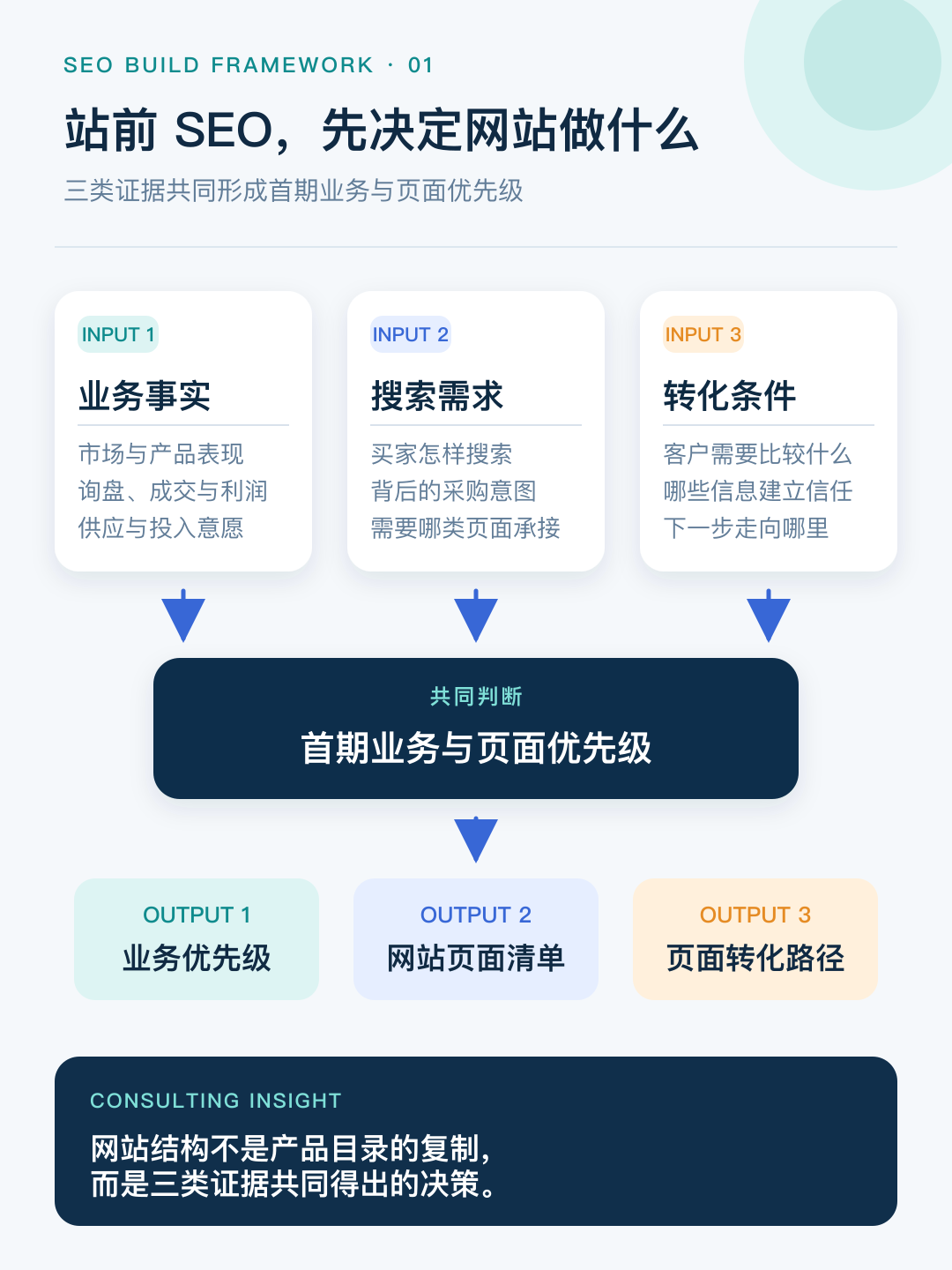
We are currently researching SEO before the build for a new-site project. We do not start by generating a keyword spreadsheet. We assess three kinds of information together:
**Business facts:** current market and product performance, qualified inquiries, sales, margins, supply capability and future priorities;
**Search demand:** how customers search, the purchasing intent behind it and the page type needed;
**Conversion conditions:** which product, application, selection and credibility information customers need before requesting quotes, samples or further discussion.
Platform data supplies clues, not a replacement for business judgment. Impressions, visits and inquiries are not sales. The client must confirm actual transactions, product strengths and willingness to invest.
**The output:** first-phase business priorities, a page inventory and conversion paths connecting pages.
Pre-build SEO planning answers what the site should do and why. It is an input to the website plan, rather than a report added after completion.
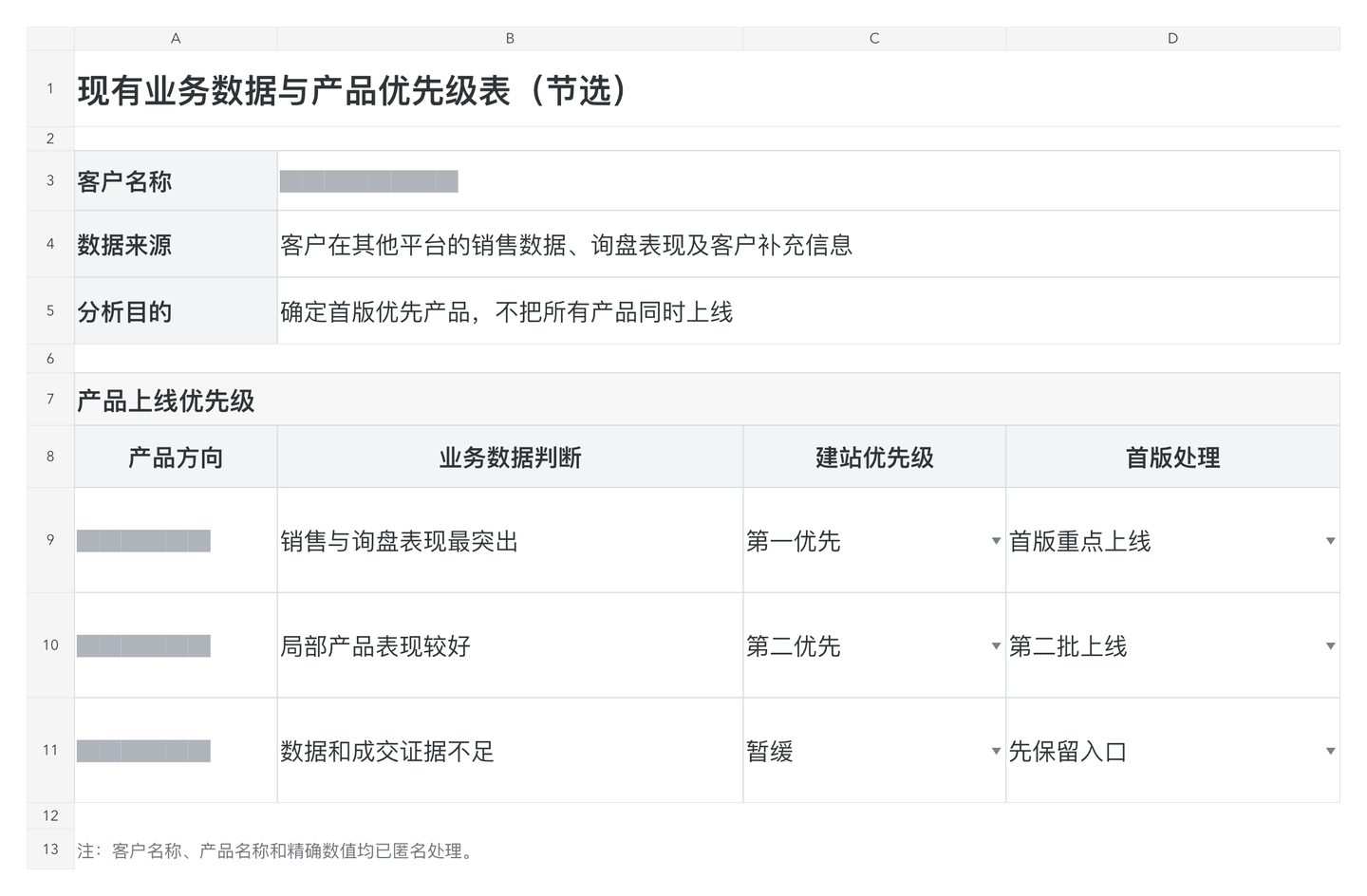
For this project, we have organized the research into a business-priority assessment. It contains business judgments, product evidence, entry keywords, a quick client assessment and definitions, ultimately setting the investment order across three business lines and product priorities within the leading line.
Second point: implement the plan during the build
**The question:** how does the pre-build plan become a site that visitors can access, understand and use to make inquiries?
The common problem is planning and development proceeding separately.
The report identifies priority products, page roles and inquiry paths, but development reuses an old template. Priority pages never enter navigation, product pages contain only images and specifications, and every button leads to one generic contact form. The report is finished and the site launches, but they are not connected.
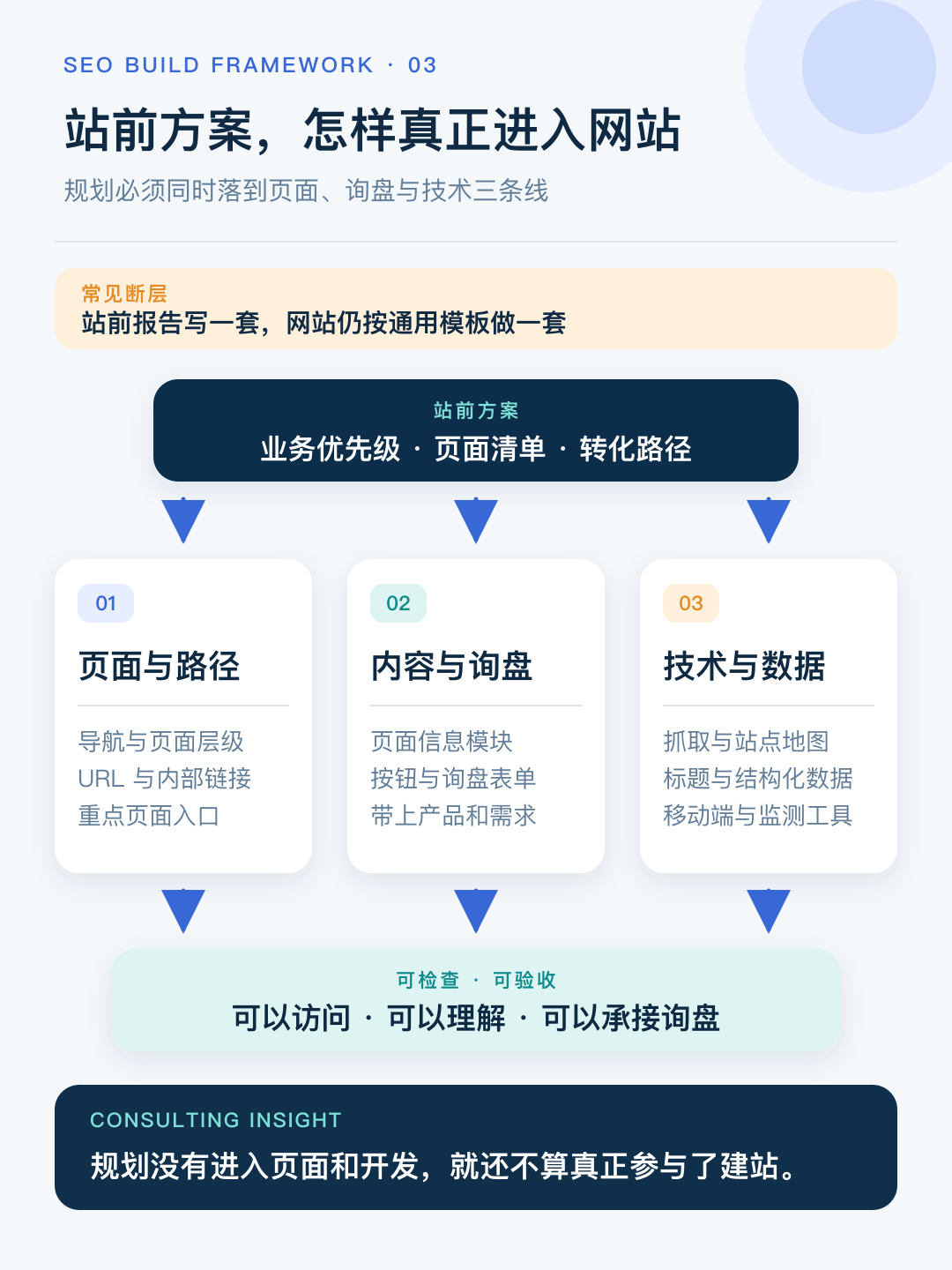
Three areas therefore need implementation during the build:
**Pages and paths:** turn the page inventory into navigation, hierarchy, URLs and internal links;
**Content and inquiries:** turn buyer questions into modules, buttons and forms, with a clear next step;
**Technology and data:** implement crawlable links, sitemaps, titles, mobile support and necessary structured data, and connect tools for later monitoring.
Google's search guidance for developers identifies crawlable links, sitemaps, page text and structured data as development considerations. Its SEO Starter Guide also recommends clear structures and URLs to help users and search engines understand page relationships.
**The output:** a website implemented against the pre-build plan and ready for inspection and acceptance.
SEO during development does not redecide which products to promote, nor is it yet long-term operations. It connects business direction, content, inquiries and technical foundations, rather than merely claiming the website has “SEO features.”
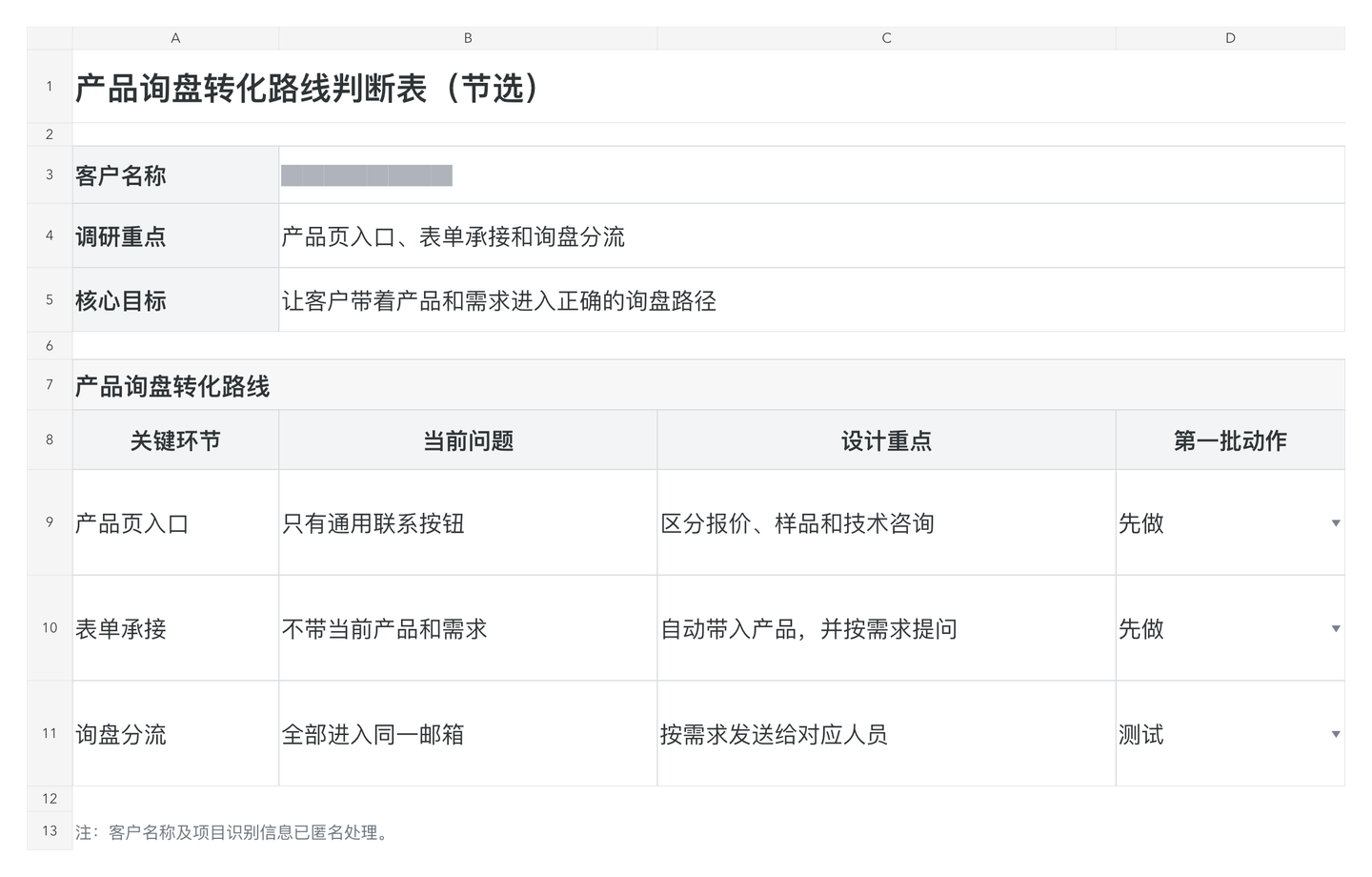
For inquiry conversion, we have already delivered and discussed a conversion-path design with the client. It covers not only extra form fields, but how product pages address demand, how different inquiries are routed and how the finished work should be accepted.
Third point: use data and iterate after launch
**The question:** what should be optimized next, and which directions do not yet deserve investment?
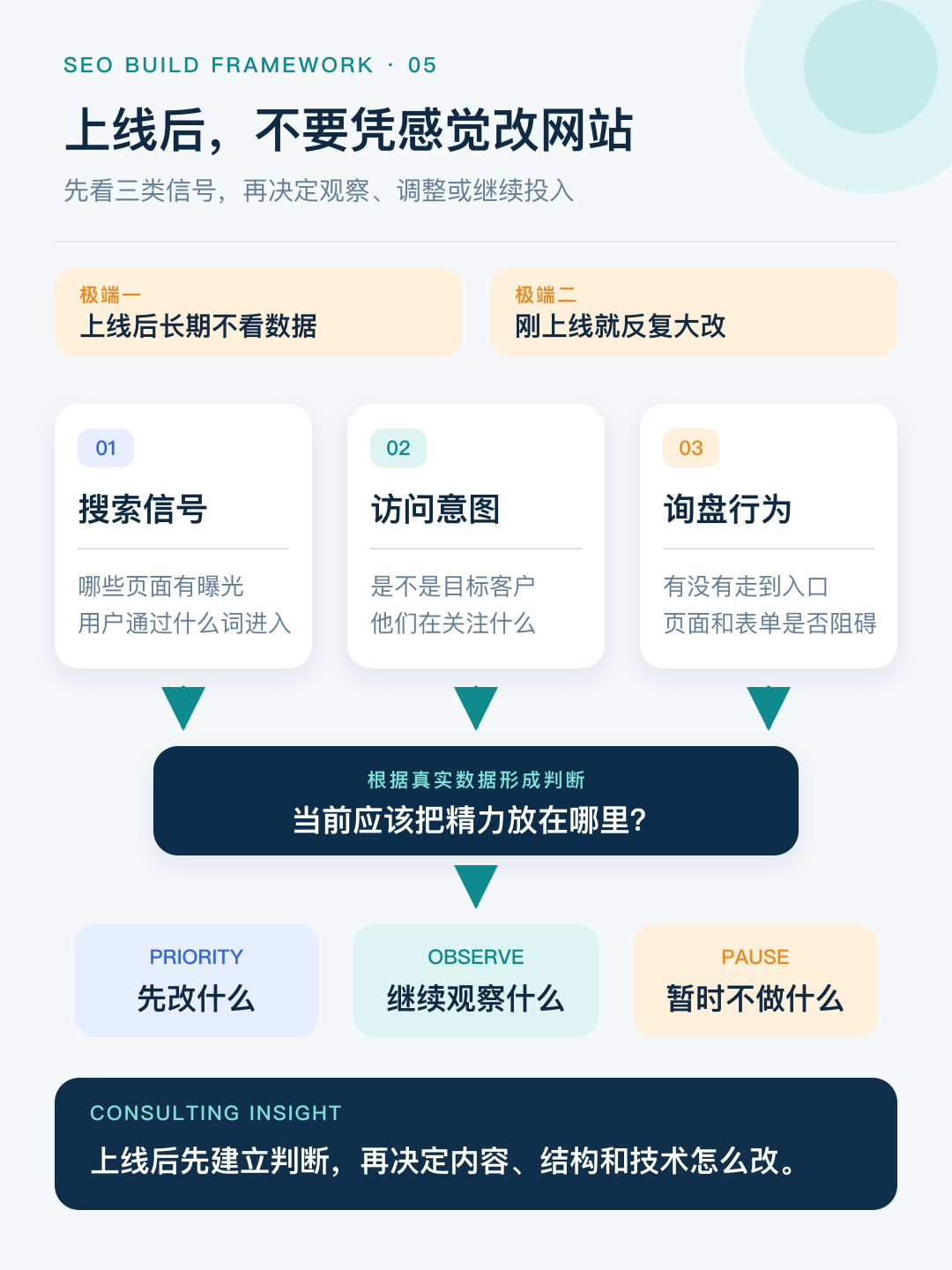
Two extremes are common. One treats launch as the end and ignores search and inquiry data for months. The other sees little traffic immediately and starts changing structure, replacing keywords or publishing large volumes of articles.
The first misses problems; the second acts without enough evidence. Post-launch SEO is not simply ongoing blogging. First examine three signals:
**Search signals:** which pages receive impressions and which queries bring visitors;
**Visitor intent:** whether visitors are target customers and which products or content interest them;
**Inquiry behavior:** whether customers reach inquiry actions and whether pages or forms create friction.
Then decide whether to add product information, adjust pages, add applications or cases, create new content, or first fix technical and inquiry-path problems.
**The output:** an evidence-based optimization priority list—what to change first, what to keep observing and what to defer.
Ongoing work should be scoped separately using actual data. It is not indefinitely included in a one-time build and cannot promise fixed rankings, traffic or inquiries. A project still under construction can demonstrate planning and pre-build decisions, but should not be presented prematurely as a success story.
Does every project need a separate SEO plan first?
Not necessarily. The deciding factor is whether scope is already clear.
If priority markets, products and inquiry goals are established, planning and development can proceed together, with research feeding directly into structure.
When multiple markets, complex product lines, existing assets, languages or several teams leave key questions unanswered, diagnosis or website solution definition should come first.
The distinction is not whether SEO is needed. It is whether the available information supports a plan that can be implemented and accepted.
Related reading
Your Own Website Should Amplify Existing Sales Strengths, Not Just Be Another Rebuild
You Paid for an English Export Website. Why Is It Still Struggling Six Years Later?
Plan your website and SEO together
Share your products, target markets and launch plans so we can discuss website development and search planning as part of the project.