
Your Own Website Should Amplify Existing Sales Strengths, Not Just Be Another Rebuild
Your B2B platform already generates inquiries and sales, but what should you carry over to your own website and what needs fresh validation? This article explains how platform and sales data can guide product priorities, page structure and new routes to customers.

Recently, we have met several industrial companies preparing to build their own websites. They already have product data, inquiries, completed sales and target-market feedback from B2B platforms such as Alibaba.com and Made-in-China.
They now want to move gradually from relying on one platform to operating a platform and their own website in parallel. The platform continues, while the website reaches customers elsewhere and gives the company greater control over content, traffic and inquiry channels.
But when the build begins, a question emerges: how should platform sales data and customer experience guide the website? Which strengths can be amplified, and which assumptions need testing outside the platform?
This article concerns companies with an existing platform business, rather than those starting from nothing. It asks how their own website can build on the sales strengths they have already developed.
With existing platform inquiries, you are not starting from zero
On third-party B2B platforms, product categories, search entry points, detail-page formats and inquiry forms are largely defined for you. Companies upload products, gain exposure and respond to inquiries within those rules. The platform supplies the basic framework for buying and selling.
That framework does not automatically exist on your own site.
Simply copying platform product titles, images and specifications may produce little more than a product catalog detached from the platform.
It can help existing customers, trade-show contacts and visitors brought by salespeople check information. But it may not help unfamiliar buyers find products through Google, select the right option, assess supply capabilities or submit useful inquiries.
A company that has succeeded on a platform is therefore not starting a business again. The job is to retain what the platform has already validated and build the capabilities the platform did not create for the company.
First clarify what the website should amplify
“We want the website to grow our business” is not yet a usable website-building objective.
Some companies want Google search traffic beyond the platform. Others want trade-show prospects, email outreach contacts and sales leads to explore technical information. Others plan to enter new countries or applications and gradually reduce dependency on a single platform.
These objectives can coexist, but first answer: which customers should find the site, and what should they do after arriving?
Distributors may prioritize product range and dependable supply. Engineers may look for specifications, compatible materials and test data. Procurement staff may assess certifications, lead times, customization and quotation methods.
Without these answers, product categories, page content, languages and inquiry journeys lack a clear business basis.
Use sales data to identify strengths already established
The platform has impressions, visits and inquiries. Salespeople have customer countries, applications, quotations and transaction feedback. Internally, the business knows which products offer better margins, steadier supply or stronger customization capabilities.
That information should first answer four business questions:
Which products have generated relatively qualified inquiries or sales?
Which markets, industries and applications do those customers represent?
Which specifications, certifications, delivery and customization questions recur before a quote?
What ultimately wins orders: the product, price, technology, delivery or a particular supply capability?
Do not focus only on the product with the most impressions. Impressions show visibility; inquiries and sales provide stronger evidence of purchasing demand. Whether to invest further also depends on margins, supply capability and the company's future priorities.
The outcome is not a platform product leaderboard. It is a set of products, markets and customer needs worth validating further on the company's own website.
Then assess whether those strengths can attract customers beyond the platform
Platform results arise within the traffic and trading environment the platform supplies. On an independent site, the company must establish its own routes to customers.
Product names used on a platform may differ from the terms people use on Google. Buyers might search directly for a product or begin with a material, application, machine, specification or specific problem.
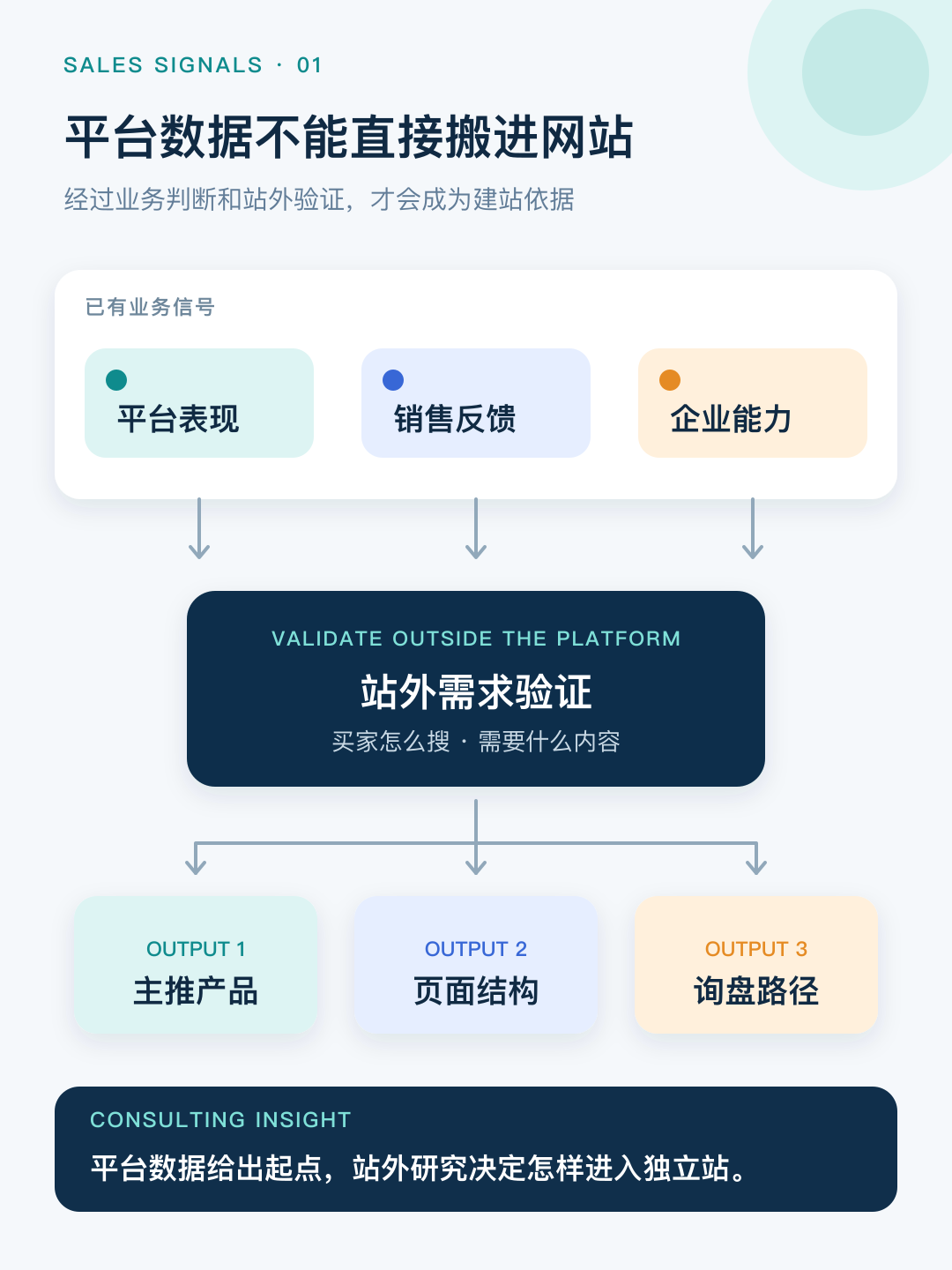
Research outside the platform therefore does not mean selecting products all over again. It tests how established strengths should enter the website: whether corresponding demand exists, how buyers name the products, whether searches seek products, selection guidance or suppliers, and whether existing materials answer those needs.
Platform and sales data answer where the company already has strengths. External research asks whether those strengths can create new routes to customers.
How an industrial project turned platform data into a basis for the website
A recent industrial project followed this process. The client had accumulated product performance, inquiry and sales feedback across several business lines on a B2B platform and now wanted its own website.
What it lacked was not a product catalog, but a shared basis for deciding the site's priorities.
Identify products with existing sales signals. We first organized available platform product and inquiry data, comparing impressions, visits and inquiries to distinguish products that were merely visible from those showing clearer purchasing signals.
Confirm converting products and the product structure. Salespeople added inquiry quality, sales outcomes, supply capabilities and future promotional priorities, excluding directions where the data looked promising but the business lacked a sustainable sales advantage.
Research SEO and market data in depth. We then examined target-market search demand and competing pages to understand how buyers found these products outside the platform, whether the company's materials could support the relevant pages, and what business information remained missing.
Only after these assessments did the data become a basis for the build: how to organize products, which content needed emphasis, which specifications and applications belonged on one page, and what the company still needed to confirm.
Sales strengths can grow only when research becomes website structure and content
Research identifies strengths and tests opportunities. Their amplification happens when the findings are implemented.
Products that generated qualified inquiries can receive clearer entry points and more complete pages. If customers select by material, application or equipment, the site cannot categorize only by internal model numbers. Questions repeatedly answered by salespeople can become product, application and technical content.
Factory capabilities, certifications, tests, customization and delivery experience that help win orders must become evidence buyers can inspect and verify. Otherwise, the site explains what the company sells without explaining why buyers should request a quote.
If salespeople routinely need to ask about materials, dimensions, quantities and applications after receiving inquiries, the site's quotation journey can help customers supply those details in advance, rather than offering only name, email and message fields.
Visitors from platforms, trade shows, email outreach and customer referrals can return to the same site to explore products and submit requirements. The site's traffic, search and inquiry data then inform the next round of product and market decisions.
Platform and sales data → validation of demand beyond the platform → website structure and content → new visits and inquiries → further adjustment using new data
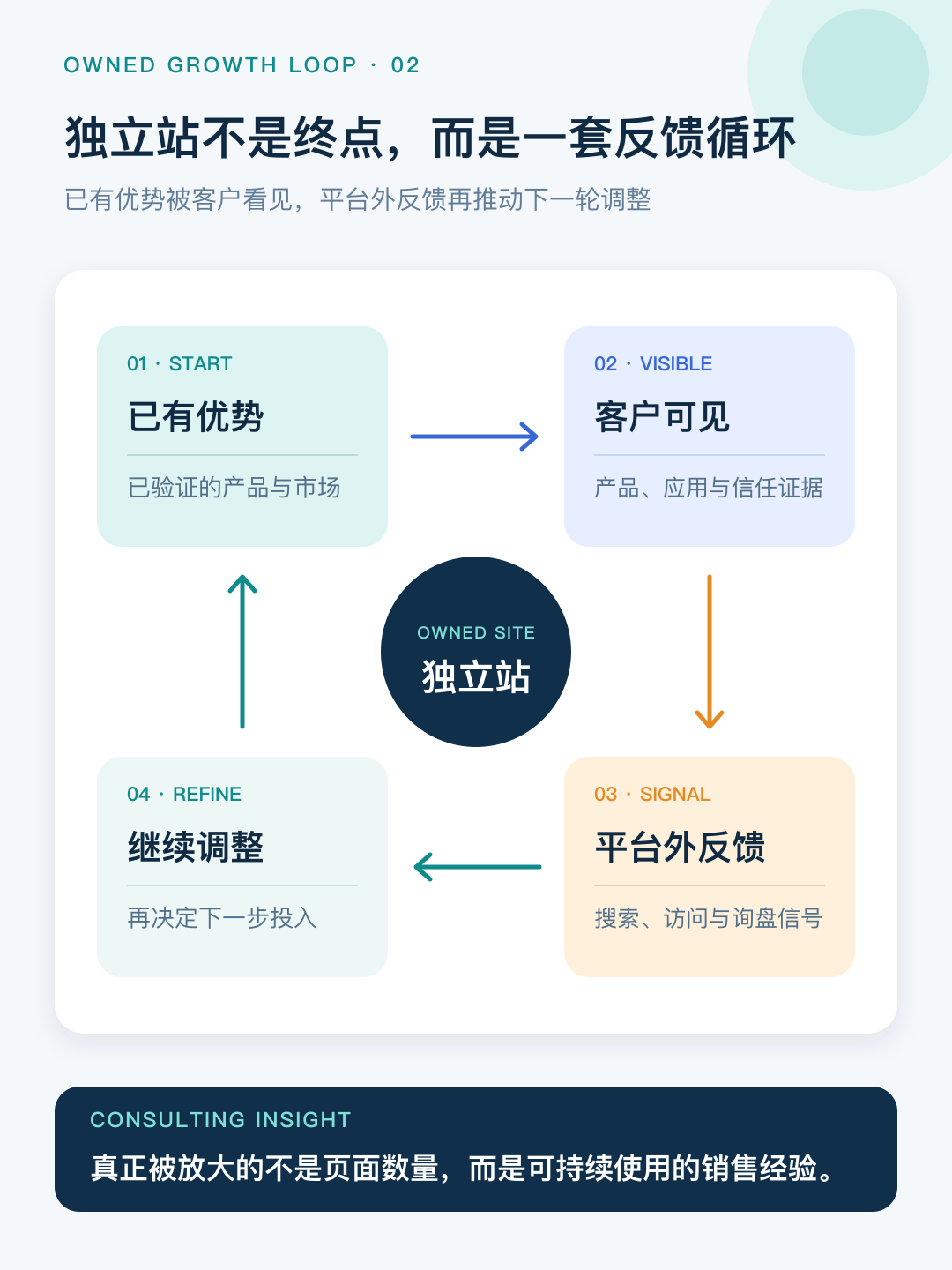
The platform can continue providing demand and transaction trust within its environment. The company's own site adds customer access and market feedback that it controls.
“Amplifying existing sales strengths” therefore does not promise a certain number of new inquiries immediately after launch. It means gradually turning proven products, markets and sales experience into business assets the company can continue using.
Related reading
Should SEO for an Export Business Website Start Before the Build or After Launch?
You Paid for an English Export Website. Why Is It Still Struggling Six Years Later?
Build a website around your sales process
Tell us about your sales channels, product information and recurring buyer questions when planning a new website or redesign.
References and notes
The case draws on recent industrial website consultations and the organization of platform product performance, inquiries, sales feedback and search demand in an anonymized project. It does not yet demonstrate post-launch traffic or inquiry outcomes.