
Why Do Export Website Quotes Differ So Much?
Quotes for building or redesigning an export business website can differ severalfold. This breakdown examines development, renewals, SEO, inquiry journeys and acceptance responsibilities so you can compare proposals on the same basis.

When commissioning an export business website, you often face a difficult comparison:
Similar-looking requirements receive quotes ranging from a few thousand to tens of thousands of yuan. Other proposals bundle development, SEO, AI search visibility—often called GEO—and overseas promotion at an even higher price.
The problem is that these quotes often cannot be compared directly.
Some cover only page production. Others include product structure, English content, search-page planning and inquiry journeys. Some are one-time build fees; others include a year of operations.
They all describe an “export business website,” but may be selling very different services.
The first question is therefore not who is cheapest, but what the money buys, what it excludes and who will do the remaining work.
1. Separate a quote into three kinds of cost
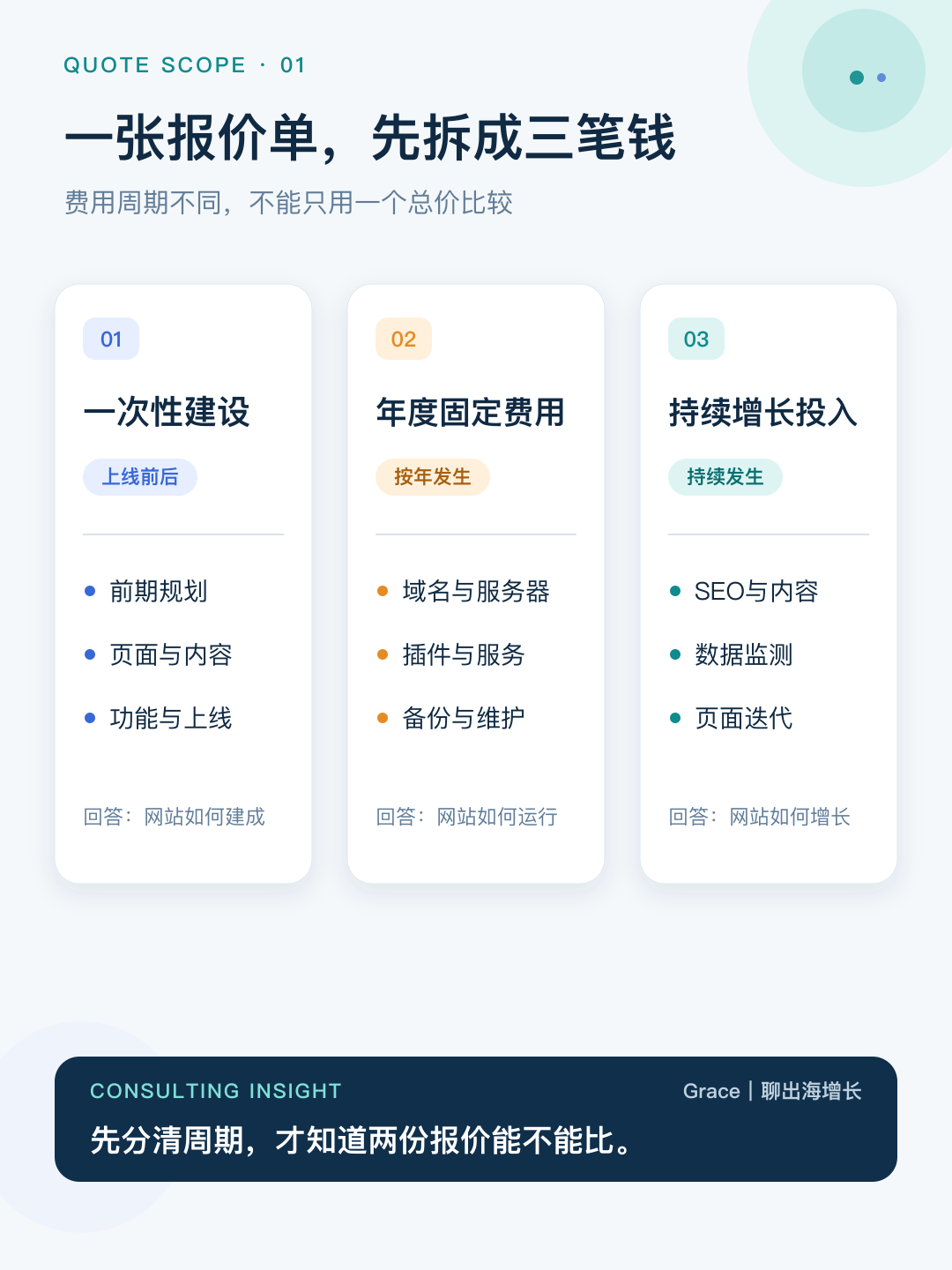
Many quotes are difficult to compare because they combine three different cost categories.
First: one-time development costs
These turn requirements into a launch-ready website. They may cover planning, visual design, page production, feature configuration, content organization, product entry, measurement setup and launch checks.
Some providers accept the client's sections and materials and build pages to a list. Others first reassess products, customers, markets and the role of each page.
Both can deliver a website, but their scope differs substantially.
Second: fixed costs after launch
Common items include the domain, hosting, paid plugins, backups, security and technical maintenance.
Some renew annually, some include the first year in the build price, and some are purchased directly from third parties. SSL certificates and CDNs do not always require separate fees; that depends on the technical approach and service terms.
Before signing, ask more than whether there is a second-year renewal. Ask what renews, who receives payment and what happens if it does not renew.
Third: ongoing growth investment
SEO content, backlinks, advertising, social media, data analysis and GEO monitoring require continuing investment. They do not happen automatically after launch and should not be hidden inside vague phrases such as “SEO-friendly” or “promotion across the web.”
A proposal including six or twelve months of operations cannot be compared directly with one ending at launch.
Which costs does AI change?
AI can shorten work on page drafts, repeated page production, copy and translation drafts, and product-data organization. Those efficiencies should be reflected in the scope and quote.
But AI does not eliminate market and product decisions, website structure, keyword-to-page mapping, inquiry journeys, content review, technical testing or maintenance. Rather than merely asking whether AI is used, ask which work it supports, who reviews and tests it, who fixes problems and what defines final acceptance.
For a closer look at which steps AI can save, see “Building an Export Business Website Quickly: Which Steps Can AI Save You, and Which Can It Not?”
2. Look beyond “template, semi-custom or fully custom”
Providers often explain pricing through these three labels.
The distinction is convenient, but imprecise.
A template is not synonymous with poor quality. A mature template configured well can support clear product structure, distinct pages and routine updates. Conversely, designing every page from scratch does not automatically address search, content or inquiries.
“Semi-custom” is particularly ambiguous. It may mean a visual reskin, product categorization and content organization, or a package including keyword research, page mapping and inquiry design.
The same label has no universal delivery standard.
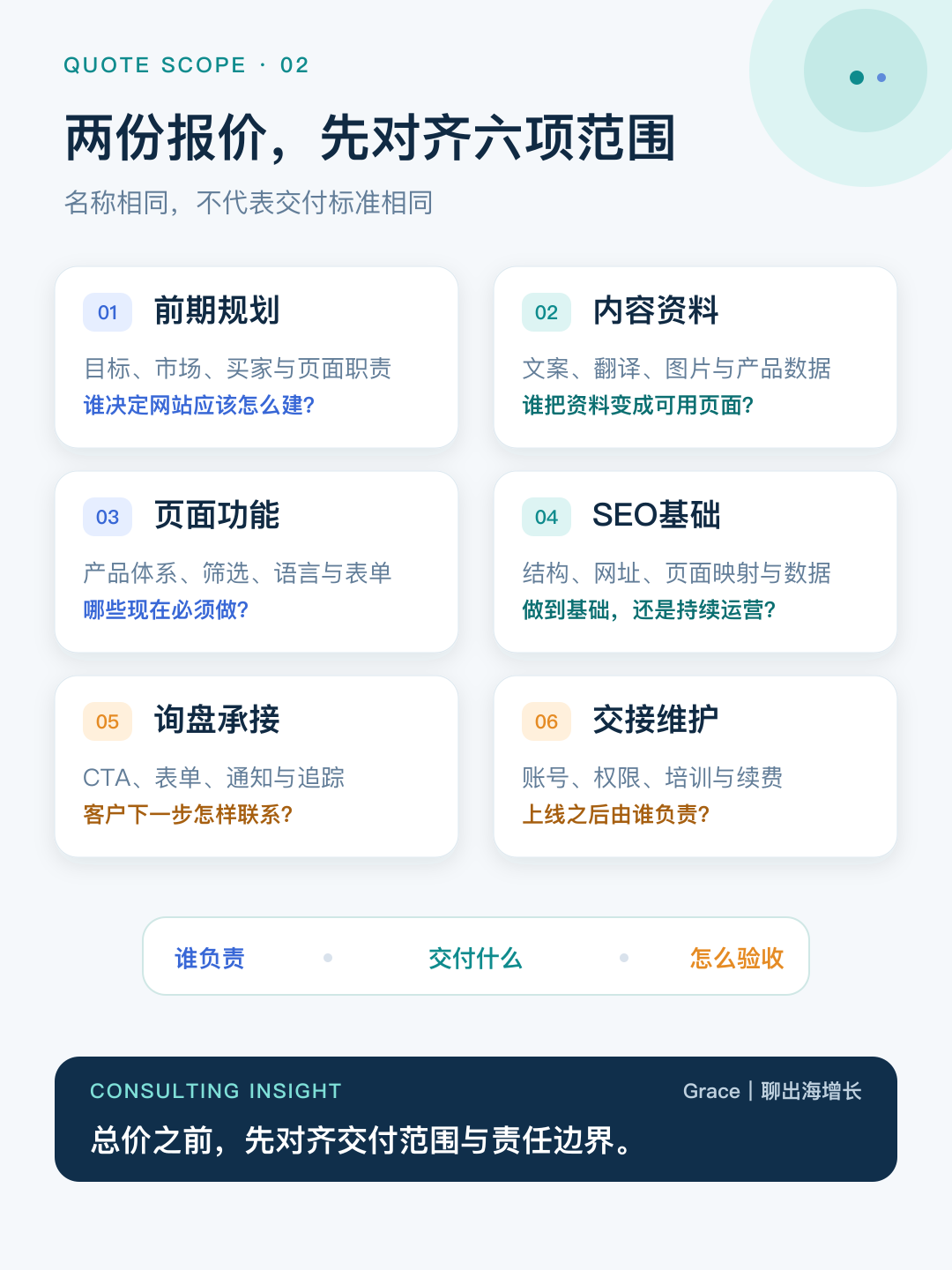
Instead of asking whether a site is custom, ask how far each of the following six areas is covered.
3. Align these six areas before comparing quotes
1. Planning: who decides how the website should work?
Does the quote include examining products, target markets, buyers and website goals?
If the client only needs an English presentation site supporting trade shows and sales outreach, priorities may be company information, product materials, credibility and contact details.
If unfamiliar buyers should find the site through Google, search demand, page roles and future content also need consideration. Different goals imply different structures and investment.
2. Content: who turns existing material into usable pages?
“The client supplies materials” may mean handing over a catalog, or it may require the client to finish all Chinese and English copy, images, specification tables and product categories.
Confirm:
Who writes and reviews English copy;
Who prepares product images;
Who cleans and enters specifications;
Whether existing content is copied or reorganized;
Who checks translations against business facts.
Equal page counts can still involve very different content workloads.
3. Pages and features: “product center” is not enough
A product center is a section name, not a clear deliverable.
The number of categories, filters, search, downloads, languages, inquiry fields and integrations all affect effort.
Separate what is essential now from what might be needed later. Building complex features for unvalidated needs may not be worthwhile.
4. SEO foundations: installing a plugin or matching search demand to pages?
SEO is not a switch or a completed task after installing a plugin.
During the build, establish whether search engines can discover and understand the site, whether important pages are linked clearly, how URLs and basic page information are configured, and which page serves each search need.
These belong to the website foundations and launch planning.
Ongoing content, link building, data reviews and page optimization form another stage. Their inclusion depends on scope, not whether the quote contains the letters “SEO.”
For more on this distinction, see Should SEO for an Export Business Website Start Before the Build or After Launch?
5. Inquiry conversion: a Contact Us page is not a complete inquiry journey
What customers see on a product page, why they continue, and whether the next step is downloading material, requesting samples or asking for a quote all need planning.
Clarify:
Which pages carry the main inquiry actions;
Which fields customers complete;
Who receives submission notifications;
Whether necessary tracking is configured;
Who tests the entire submission process.
This makes the journey more complete, but does not guarantee a number of inquiries.
6. Handover and maintenance: who manages the site after launch?
Define whose account holds the domain, who purchases hosting, whether source code and CMS access are delivered, how paid plugins renew and who handles backups, security and faults.
If the company will update products itself, confirm usability, training and the support period after delivery.
A sustainable website must do more than open on launch day. Someone must know how to update, maintain and hand it over later.
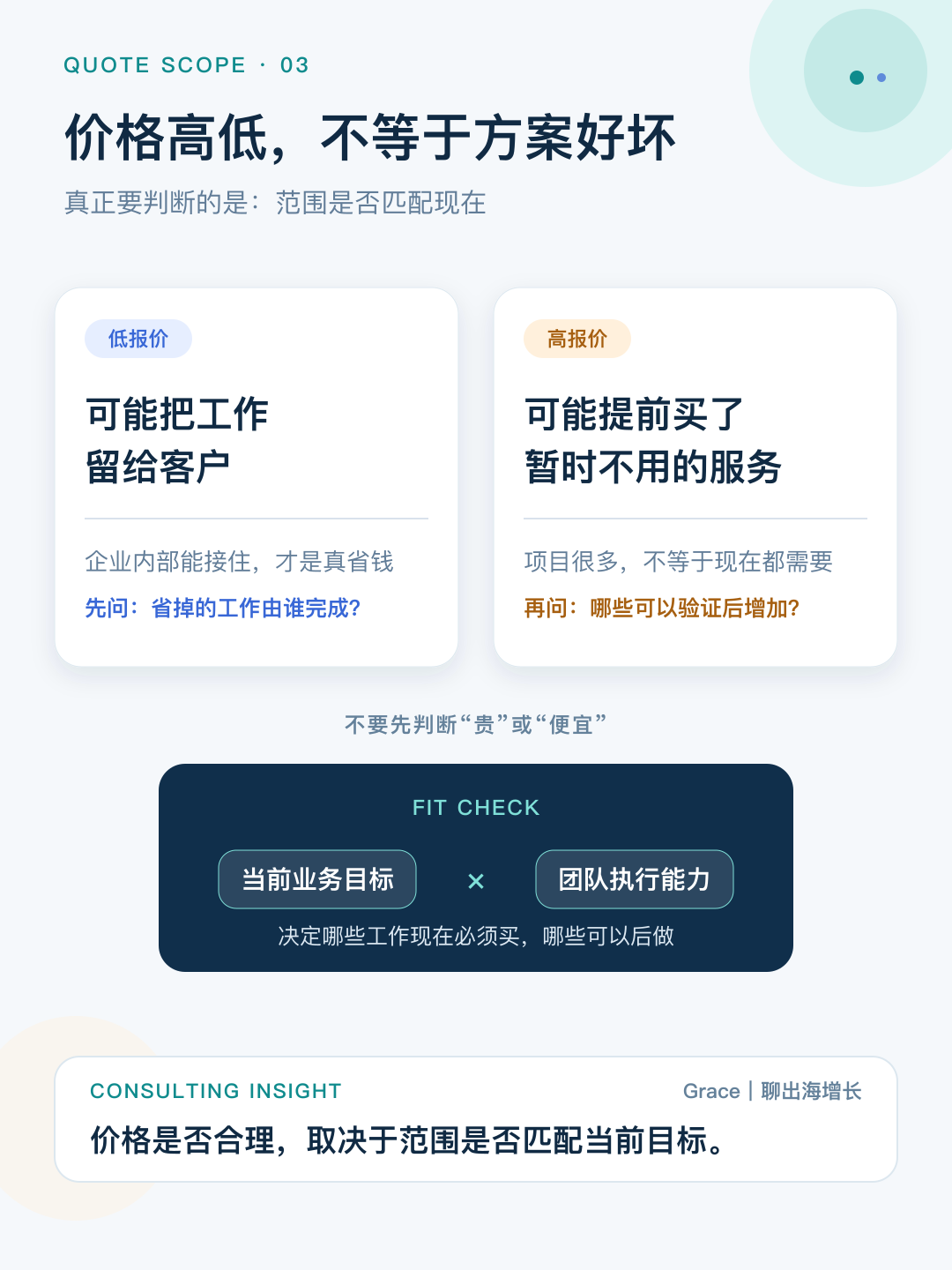
4. A low quote may simply leave more work to the client
A low price may reflect a clear division: the provider builds, while the client handles planning, copy, translation, images and product entry.
For a company with mature export, content and technical teams, that may fit well.
Without people able to do that work, the project may stall:
The framework is ready, but English materials never arrive;
Products are uploaded, but categories do not match how buyers choose;
Pages work, but nobody owns search planning;
Forms exist, but notifications and follow-up are untested;
The site launches, but nobody knows how to edit it safely.
The real question behind a low price is: do we have people internally to perform the work we are not buying?
If yes, a smaller outsourced scope may save money.
If no, the low quote has merely moved costs into later execution.
5. A higher quote may include things you do not need yet
More expensive does not automatically mean more suitable.
Some proposals bundle multiple languages, complex membership features, ERP integration, year-round SEO, advertising, social media and GEO. They look comprehensive, but the company's products, markets, content and internal owners may not be ready.
Ask:
What must be finished for launch?
What can wait until the market is validated?
What belongs to continuing operations rather than build acceptance?
What happens if an item is deferred?
Bundling everything does not always simplify matters. It can obscure responsibility and make it difficult to tell what was achieved after a year.
6. How should SEO and GEO appear in a website quote?
A clearer approach separates them by stage.
Website foundations
Structure, accessible pages, internal links, URL rules, basic page information, sitemaps and necessary measurement setup.
Launch planning
Target-market and search-demand research, keyword-to-page mapping, priority pages and subsequent content needs.
Ongoing growth
Content production, backlinks, advertising, social media, data reviews, page iteration and AI search visibility monitoring.
The first two can form part of the build according to complexity. The third usually requires a separate agreement on duration, investment, responsibilities and acceptance.
The same applies to GEO. Specify whether it covers website content foundations, consistent brand information, third-party sources, or ongoing monitoring and content operations. That is more useful than a line saying “GEO optimization.”
These activities strengthen the basis for discovery and understanding. They should not promise particular rankings, AI citations or inquiry results.
7. Clarify eight questions before signing
Before comparing totals, ask:
Which pages, content and features will be delivered?
Who handles copy, translation, images and product information?
Which SEO foundations, launch-planning tasks and ongoing work are included?
Which tasks use AI assistance, and who reviews, tests, revises and accepts the work?
Are product entry, migration, languages and third-party integrations charged separately?
Who ultimately owns the domain, hosting, source code and CMS access?
Which second-year renewals are required or optional, and what happens without them?
How is each item accepted, and how long does post-launch support last?
Only when two providers answer these clearly do you have genuinely comparable quotes.
8. A few thousand yuan or tens of thousands can both be reasonable
If the company needs a basic English presentation and can prepare content, upload products and maintain the site itself, a lighter scope can be appropriate.
Many products, complex markets and languages, or the need to reorganize content, existing assets, search pages and inquiry journeys naturally increase planning and implementation scope.
The real danger is a different understanding of “website completed,” rather than a high or low price alone.
The client may expect foundations for sustained acquisition while the provider accepts only pages going live. Or the company may need market validation but buy a year of promotion before it is ready.
Align goals, deliverables, responsibilities, renewals and acceptance first. Only then does comparing prices become meaningful.
Related reading
Should SEO for an Export Business Website Start Before the Build or After Launch?
You Paid for an English Export Website. Why Is It Still Struggling Six Years Later?
Building an Export Business Website Quickly: Which Steps Can AI Save You, and Which Can It Not?
Comparing website quotes? Send us your materials first
If you have a website, product materials or proposals from providers, email your existing URL, main products, target markets and the questions you find hardest to assess. We will review them and determine whether to continue by email or arrange a technical or SEO consultation.
Source notes
The observations about market pricing draw on a supplied collection of 33 Xiaohongshu posts and public webpages. They identify common quoting practices, rather than actual transaction prices, market shares, complaint rates or customer choice proportions.