If AI Can Translate Automatically, Why Can't Export Businesses Add More Languages Immediately?
You already have an English website and AI can translate quickly, so why do additional languages still become difficult to manage? This guide separates the responsibilities of systems, AI and people, covering product information, synchronization rules, review and publishing.

If AI can translate websites, why do people still say multilingual sites are difficult?
Adding languages to a website now looks very simple.
Connect a translation plugin or give your English product descriptions to AI, and you can quickly generate German, French, Spanish and other versions. Much of the work that once required repeatedly engaging translation providers can now be automated.
Businesses naturally ask: if AI can translate, why does a multilingual website still need people to maintain it? Could we simply update the English version and have AI synchronize everything automatically?
That idea misses one step.
AI can already address “How should this passage be translated?” But once a multilingual site is live, the more common questions are which markets and pages a change should affect, whether it can be published directly, and who is responsible for the final content.
This is where AI's role in multilingual sites deserves attention. Its value extends beyond translating English content for the first time: it can reduce repetitive maintenance as products are added, specifications change and pages are updated.
One distinction matters here. Detecting website changes, saving versions and triggering updates are often jobs for the CMS, connectors or workflows. AI handles understanding the changes, generating content, checking consistency and helping assess risk. An effective approach gives systems, AI and people the work each is best suited to.
These are not new ideas: existing products already work this way
Platforms and service providers already offer multilingual capabilities. Their products differ, but a clear direction of development is visible.
The first group is website translation tools. They do more than machine translation: they can detect new or changed content, apply glossaries, brand voice and previous edits, and allow teams or translators to make manual adjustments.
The second group is localization management platforms. When source content changes, the system can flag affected translations and send them through review, approval and publication, rather than relying on staff to remember which pages changed.
The third group is content management and product information platforms. They centralize page content or product fields, then generate versions for different languages, regions and channels. AI can help with translation, content generation and quality checks, while publishing permissions and review responsibilities still need to be defined.
A shared source of information, AI generation, human review and synchronized updates are therefore not an improvised workflow. These capabilities already exist in products and services.
But stopping there would merely repeat vendors' feature descriptions.
The more important question for export businesses is: once AI is connected, which parts of the team's work should it actually take over?
AI's greatest value is handling each subsequent change, not just the first translation
Suppose a company updates a product page.
The change might be a replacement image, or it might involve materials, dimensions, minimum order quantities, certification status or applications. In English, this is one update. Across multiple languages, it raises a series of questions:
Which language versions contain this information?
Can previous localized wording be retained?
Do specifications and units need updating too?
Is this model sold in the local market?
Should the page title, search terminology and inquiry information change as well?
Can this update be published directly, or must someone confirm it first?
Previously, staff often compared pages one by one. As products and languages multiply, it becomes easier for the English version to change while other versions retain outdated specifications.
A maintainable workflow separates this repetitive work: the system detects changes, AI processes content, and people make the necessary business decisions.
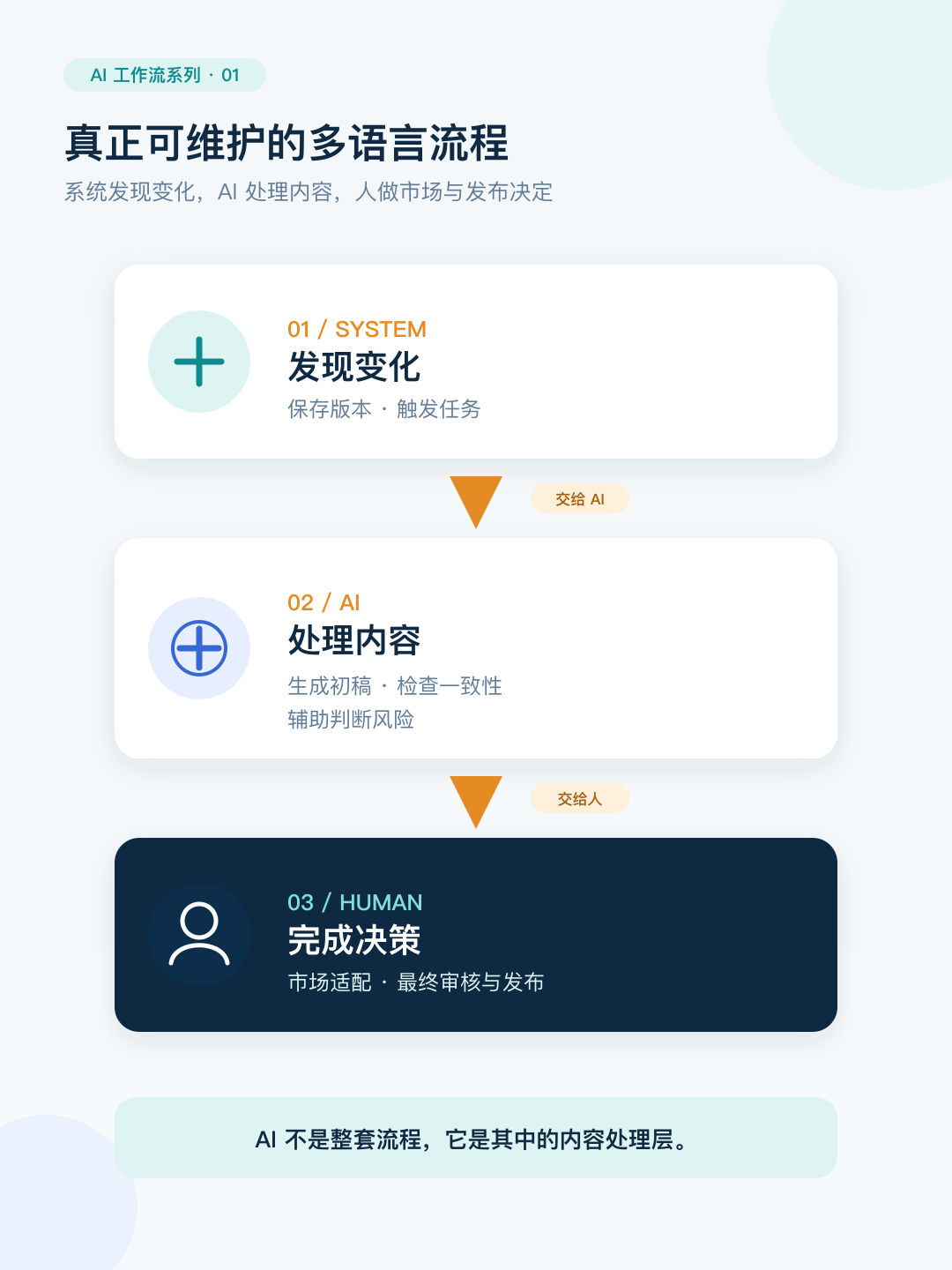
1. The system identifies what has changed
If the CMS or content system preserves old and new versions, a workflow can identify changed pages and fields and find language versions that may be affected. AI can then determine whether the change concerns specifications, marketing descriptions, image captions or page structure.
The team does not have to retranslate entire articles each time or rely on one person's memory of every previous edit.
2. Generate a controlled draft using established rules
When the company has product names, industry terminology, a brand voice and previous translations, AI can use those materials to generate a new translation draft.
The point is to provide traceable product facts and clear writing rules, rather than let AI improvise. Without those foundations, AI will reproduce the source material's inconsistencies faster and may add information that sounds plausible but does not exist.
3. Check consistency across versions
AI can also help check whether product models, materials, dimensions, units, certification names and terminology remain consistent across languages, flagging obvious conflicts or omissions.
This does not replace final business review. It lets people prioritize higher-risk areas instead of giving every word equal attention.
4. The workflow routes different content to the appropriate people
Not every page needs the same level of review.
Routine explanations and highly repetitive content may be generated by AI and checked by sampling. Specifications, certifications and delivery terms need confirmation from product or business staff. Brand messaging, advertising copy, legal and compliance content may require people in the target market or specialist providers.
AI can help assess content risk, while the workflow routes work according to company rules: automate repetitive tasks first, then send judgment calls to the right people.
AI can translate, but it cannot make these three decisions for the business
Without answers to the following questions, each additional language makes maintenance harder to control.
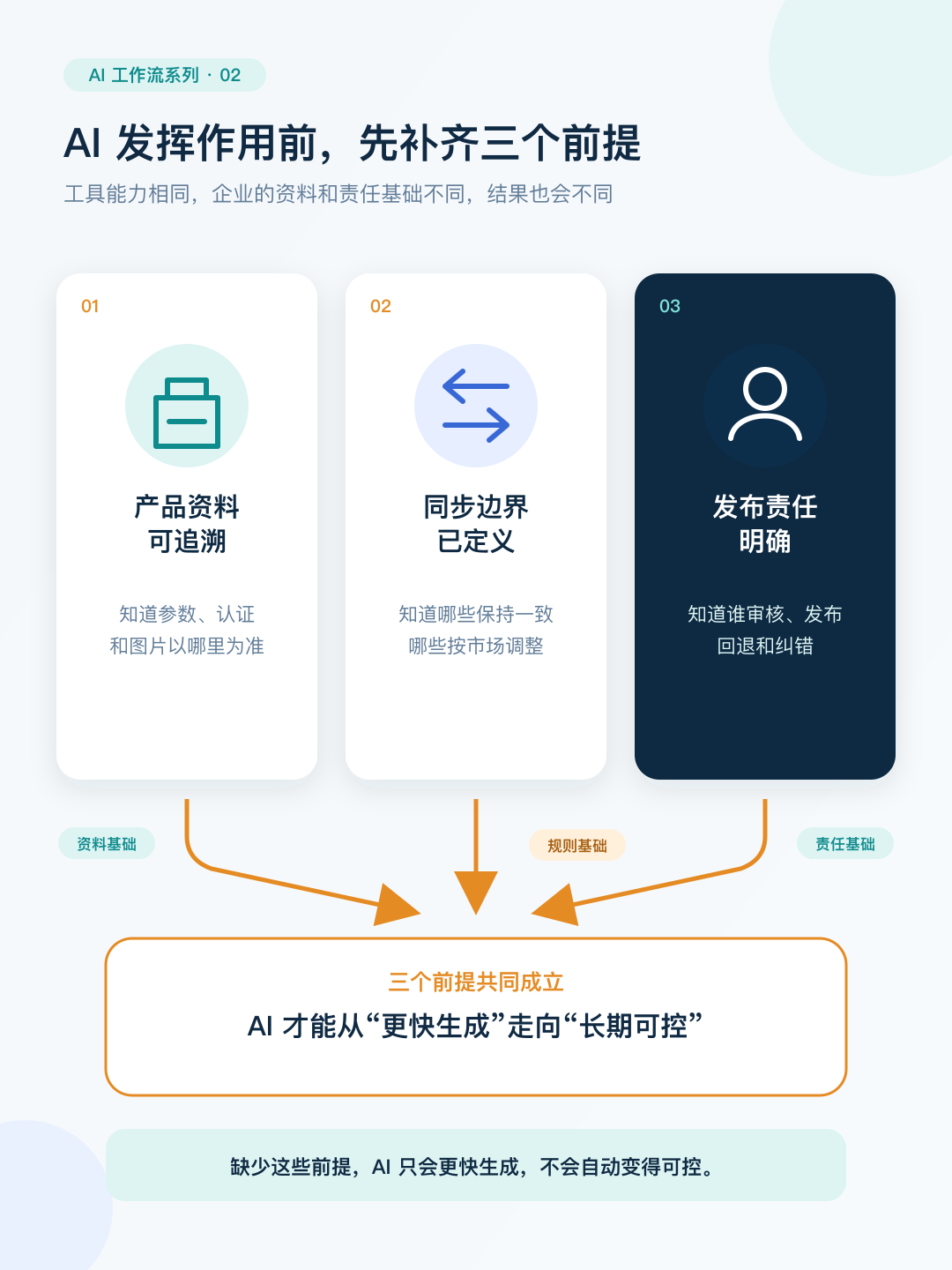
First, what is the authoritative source of product information?
Many companies use English as their website's main language, but specifications do not necessarily originate on the English page. They may be scattered across an ERP, the CMS, catalogs, spreadsheets and salespeople's own files.
English may be the site's primary language without being the right sole source for every product fact.
Before automating synchronization with AI, the company needs to establish where models, specifications, certifications, images and delivery information are authoritative, and who resolves conflicts.
If the source material is unstable, AI will not automatically put it right. It will spread the inconsistencies across more pages.
Second, what can follow the English version, and what must vary by market?
Product models and basic facts generally need consistency. But selling points, applications, industry names, search terms and inquiry methods may not transfer unchanged from English.
The same language may use different terminology in different regions. Products sold, certification requirements and communication habits can also vary between markets.
AI can suggest wording based on the context supplied. It cannot decide which markets deserve investment, which products to promote or which language fits the local business strategy.
Third, who makes the final publishing decision?
What multilingual maintenance often lacks is a clearly responsible content owner, rather than translators.
Someone must decide who edits the English content, who checks AI-generated work, which changes can publish automatically, which need business approval, and who rolls back and corrects errors.
Without that chain of responsibility, even the best translation tool simply produces content faster. It does not make the website more manageable.
Different companies do not all need a large system from day one
This does not mean every export business needs an expensive product information management system or a large localization team.
A more practical approach is to choose a starting point based on product count, update frequency and the stage of market development.
1. You only want to help existing customers read the site
If the site has limited content and infrequent updates, and the new language mainly helps existing customers understand products, a translation plugin or automatic AI translation can be a starting point.
Focus checks on core products, contact details, specifications, certifications and high-risk pages. There is no need for a complex process immediately.
2. The new market has not yet been validated
If the company is exploring a new market, choose a small group of core products and pages and run through a real update cycle.
Test more than whether AI can translate English fluently. Check whether changes to English are detected, who reviews them, how quickly updates happen and whether the team is willing to maintain the process over time.
3. You have many products, frequent updates and a long-term commitment to several markets
These companies need to establish product information sources, content fields, review responsibilities and publishing processes first. Then decide whether to use the CMS, a translation platform, lightweight connectors or a more detailed systems assessment.
Choose tools after defining the problem, rather than rolling out every language simply because AI can translate.
Answer four questions before adding a language
Is the new language just an aid to reading, or will it support local search and customer acquisition?
Where are specifications, images and certification information authoritative today?
Which content can AI process automatically, and which requires human confirmation?
After a product update, who checks, publishes and corrects the content?
If these questions remain unanswered, the immediate need may be to define how the multilingual site will be maintained, rather than buy another translation tool.
If you are still comparing translation plugins, subdirectories and subdomains, see the earlier article:
“Building a Multilingual Website: Translation Plugins, Subdirectories or Subdomains?”
The earlier article addresses language structure and translation methods. This one addresses what AI and people should each do after launch.
Is this an AI integration project or custom development?
You do not need to decide whether to buy “AI integration” or “custom development” before contacting us. They are not choices at the same level: AI integration describes the problem being addressed, while custom development is one possible implementation method.
For these needs, the main project is usually building or upgrading a multilingual website. AI translation, content generation, review workflows and product-data connections can form part of the technical work as required.
If the existing translation tools and CMS are sufficient, configuration and integration may be all that is needed;
If AI should draft other languages after product updates and send them for confirmation, it may need connecting to the existing content workflow;
If the work also involves synchronizing product data from an ERP, spreadsheets or other systems, plus permissions, records and rollback, clearly scoped custom development may be needed.
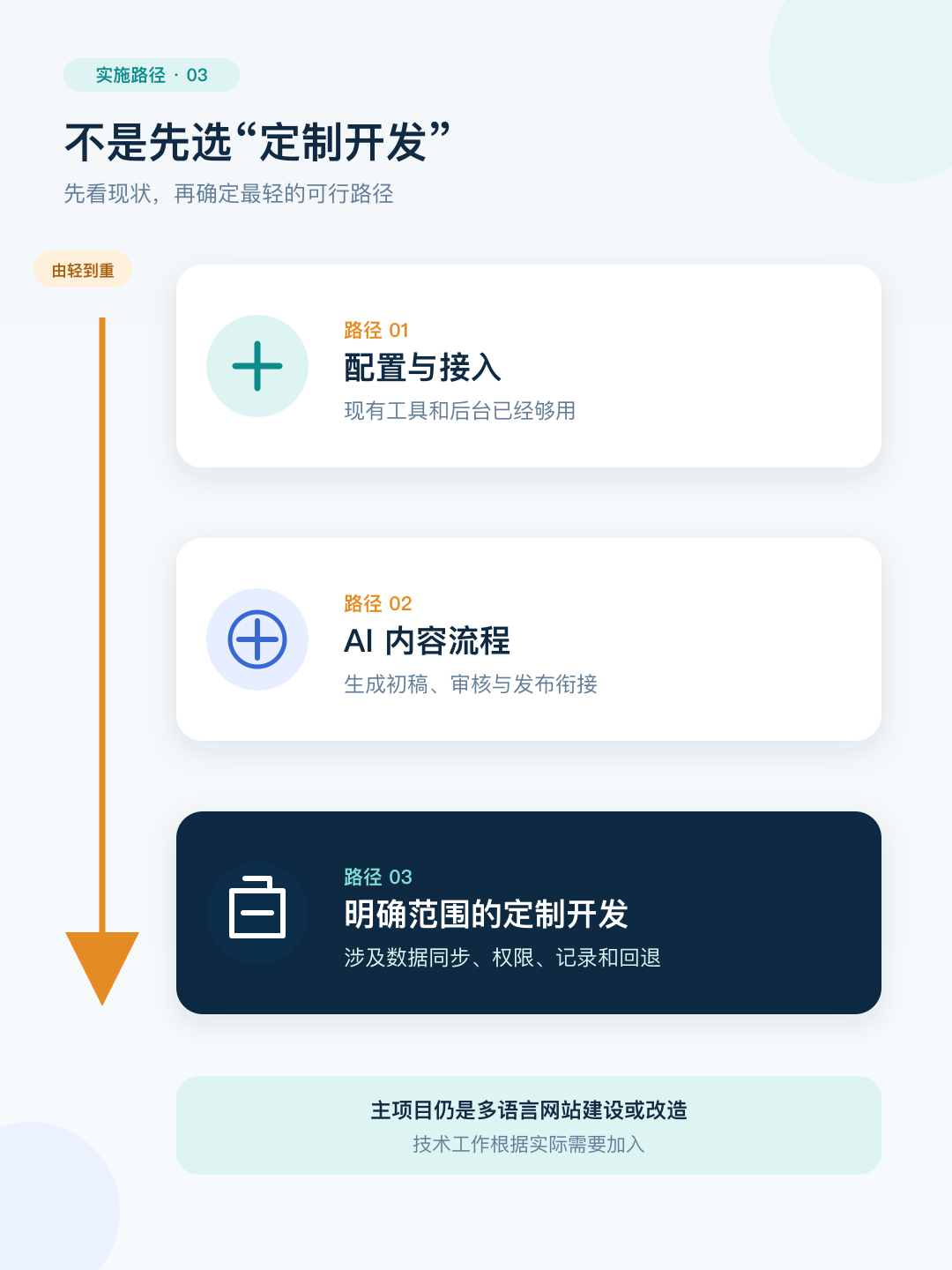
The choice depends on the current website, product information, update frequency and internal owners. The goal is a multilingual website that can be maintained, checked and handed over, rather than adding a system merely to use AI.
Reference material:
Weglot: AI translation quality
Phrase: Review Workflow
Contentful: Multilingual content marketing
Shopify: Translate & Adapt
Akeneo: How AI is changing Product Information Management
Translia: Website localization services
Note: These sources were used to verify capabilities and service approaches already available in the market. They do not constitute an endorsement of any platform. Consult each provider's current documentation for actual features, scope and pricing.
Related reading
Adding languages to your website?
Share your existing website, target markets and update process so we can discuss multilingual development and maintenance.