
After AI Overviews Take the Clicks, Is Google Starting to Pay Content Contributors?
Google is testing an AI Contribution Pilot with a small group of Search Console users. Sites may earn revenue when their content significantly influences answers generated by Gemini, AI Overviews or AI Mode. This does not mean every citation earns money, but it signals an attempt to put a value on contributions to AI answers.

Google has recently been testing a program called the AI Contribution Pilot in Search Console.
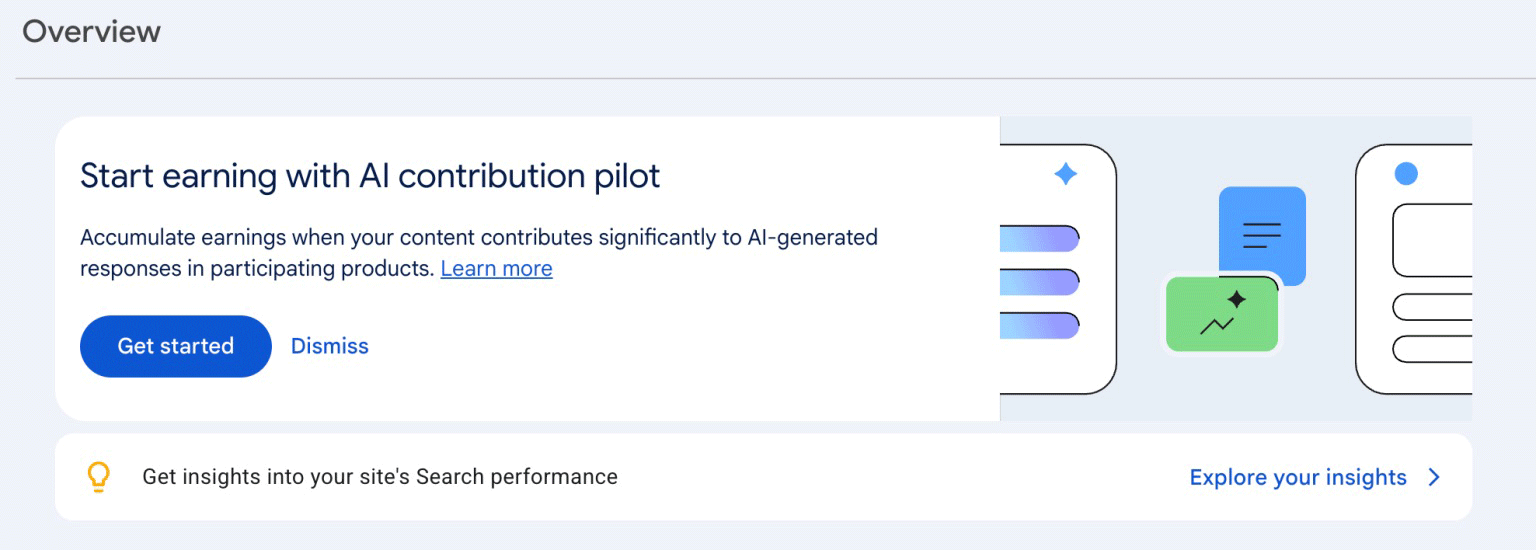 Participating websites may earn revenue if their content makes a “significant contribution” to answers generated by Gemini, AI Overviews or AI Mode. Search Console displays estimated monthly earnings and payment records.
This matters. At least within the Search Console mechanisms disclosed publicly so far, this is the first time Google has turned “a webpage's contribution to an AI answer” into an event that can be recorded, valued and paid for.
But do not rush to interpret this as “If AI cites my article, I get a share of the revenue.” Those are different things.
Ordinary citations are not what earns payment
The rules disclosed so far make a crucial distinction:
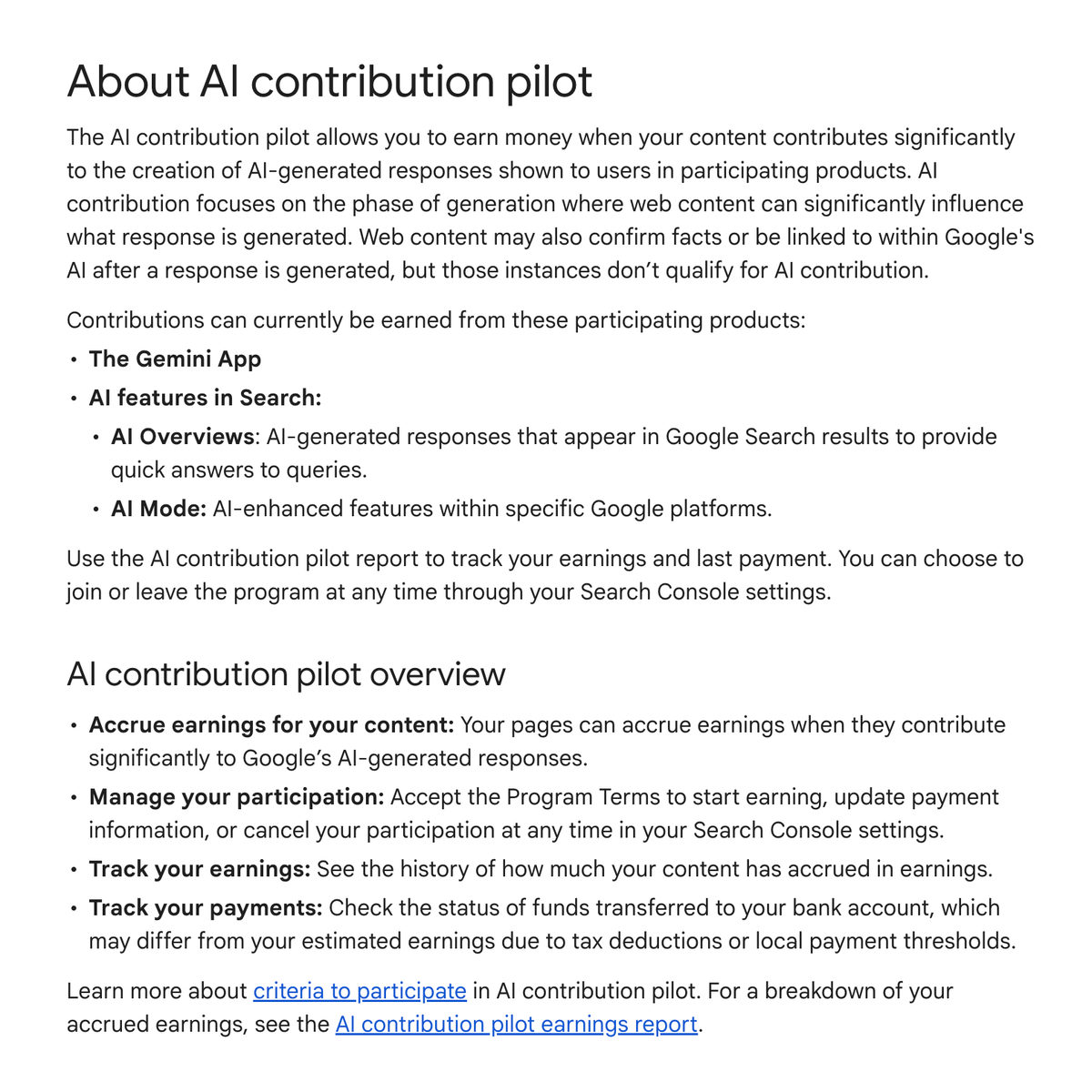
Image: Google's AI Contribution Pilot help page. It is currently visible only to some pilot accounts. The screenshot was published by Digiday; this article cross-checks it against Digiday, Search Engine Roundtable and the Google Search Console help entry point.
The explanation confirms four things: participating products currently include the Gemini App, AI Overviews and AI Mode; sites must accept the program terms before earnings begin to accrue; earnings history and payment status are available in the dashboard; and participants can leave the program through Search Console settings.
A webpage's content may count toward earnings only when it significantly influences the generation stage of an AI answer. A link added after the answer is generated, or a page used only to confirm a fact, does not qualify as a payable AI Contribution.
In other words, payment is not based on crawl counts or link impressions, and this is not an AI version of AdSense.
The real question is: how does Google determine a “significant contribution”?
There is no public formula yet. Participants can see monthly revenue, but not how much came from a particular page, answer or type of use. It remains a black box.
This is not an isolated move
The pilot becomes more interesting when viewed alongside Google's changes over recent months.
Google has brought Preferred Sources, which users actively choose, into AI Overviews and AI Mode. It has also added more prominent link carousels for some timely news, firsthand perspectives and community discussions. Inline links and website previews within AI answers are increasing too.
Google's published figures indicate that users are approximately twice as likely to click a source after selecting it as a Preferred Source.
Meanwhile, Search Console has added a generative AI performance report. Sites can now see impressions in AI answers broken down by page, country, device and date, although query and click data are not yet available.
Together, these changes suggest that the first three steps have begun to connect:
Content helps AI generate an answer → the source appears in the AI interface → the user clicks, reads further or buys.
AI Contribution adds a possible fourth step: Google assigns a value to the content's contribution and returns part of that value.
I think whether users click, quickly return or continue searching around a source could plausibly help Google calibrate content value in the future.
For now, however, that is speculation. Google has not said these interactions will directly determine AI Contribution payments, or that impressions in the AI performance report are a payment metric. Under the rules disclosed so far, ordinary impressions and a “significant contribution” during generation need to be considered separately.
Why would Google start paying?
The first reason is to sustain the supply of quality content.
The content AI can most easily answer directly is often high-traffic, top-of-funnel material: definitions, basic explanations, simple steps and common questions. Once users have an answer on the results page, they may never visit the original site.
If that content is used over the long term without generating visits or revenue, publishers have less incentive to keep investing. Google needs a route for value to flow back, or the open web that supports AI answers will gradually lose its supply of content.
The second reason is to establish a scalable way to value content.
Google cannot indefinitely negotiate licenses with major publishers one by one. Bringing participation terms, contribution assessment, earnings and payments into Search Console makes it possible to extend cooperation to large numbers of smaller websites.
The third reason is to gather the data needed to design the system.
This goes beyond collecting user behavior. Google already has extensive search interaction data. The pilot can help it understand which content improves the freshness and accuracy of answers, how to divide value among multiple sources, how much compensation encourages sites to participate, and which licensing terms publishers will accept.
There is also clear legal and regulatory value. With payment, opt-out and control mechanisms in place, Google gains another response: sites do not simply have to accept their content entering AI answers passively.
Is this an opportunity for B2B companies?
Yes, but earning content fees is not the biggest near-term opportunity.
The program is still invitation-only, with no public application route and no evidence that ordinary B2B companies can participate widely. Presenting it as “Businesses can do GEO and earn money whenever they are cited” goes beyond the available evidence.
The more practical opportunity for B2B companies is to bring their expertise into target customers' purchasing decisions.
AI does more than answer “What is this?” It also helps users compare materials, assess applications, narrow down suppliers and prepare technical questions. The contribution companies should make is not another general explanation already covered in hundreds of articles. It is firsthand information from products, customers and delivery work:
What customers most often get wrong when selecting a product;
Which conditions suit different materials, specifications and processes;
When a particular product should not be purchased;
What technical questions customers have asked and how the company assessed them;
What the test data, certifications, tolerances, lead times and customization limits are;
Which parameters must be confirmed before quoting.
This information can help AI produce more accurate answers and help buyers move from understanding a problem to assessing solutions and selecting suppliers. Even if a company never receives content revenue from Google, it may still gain more valuable brand exposure, website visits and inquiry opportunities.
B2B companies should therefore pay attention to this system, without setting their goal as “Write more articles and wait for revenue sharing.”
A more useful goal is to turn the purchasing knowledge customers actually need into firsthand material that AI and search engines cannot replace with generic content.
My assessment
The precedent established by this pilot is not that every AI citation now has a price. It is that Google is beginning to explicitly recognize a content contribution to an AI answer as something that can be valued separately and may deserve compensation.
The most useful things to watch next are not how much the first group of sites earns, but three questions:
Will Google open participation to more websites?
Will Search Console provide contribution data at the page, answer or topic level?
Will the calculation of “significant contribution” evolve from a complete black box into feedback that sites can understand and act on?
If all three happen, Search Console may eventually measure more than how many clicks a website receives from Google. It may begin answering another question:
How much value does your content actually create for Google's AI answers?
References
Google: Supporting the information ecosystem and new partnership models
Google: AI visibility, controls and performance data for website owners
Google: Preferred Sources, prominent carousels and Highly Cited labels
Digiday: Investigation into Google's paid AI Contribution pilot
Related reading
AI Overviews Expand Automatically: Even Fewer Clicks for the No. 1 Result?
What Determines Google Rankings in 2026? The Latest Views of 131 Experts
Discuss your search acquisition project
Share your target markets, products, current visits and enquiries so we can discuss website content and search operations.